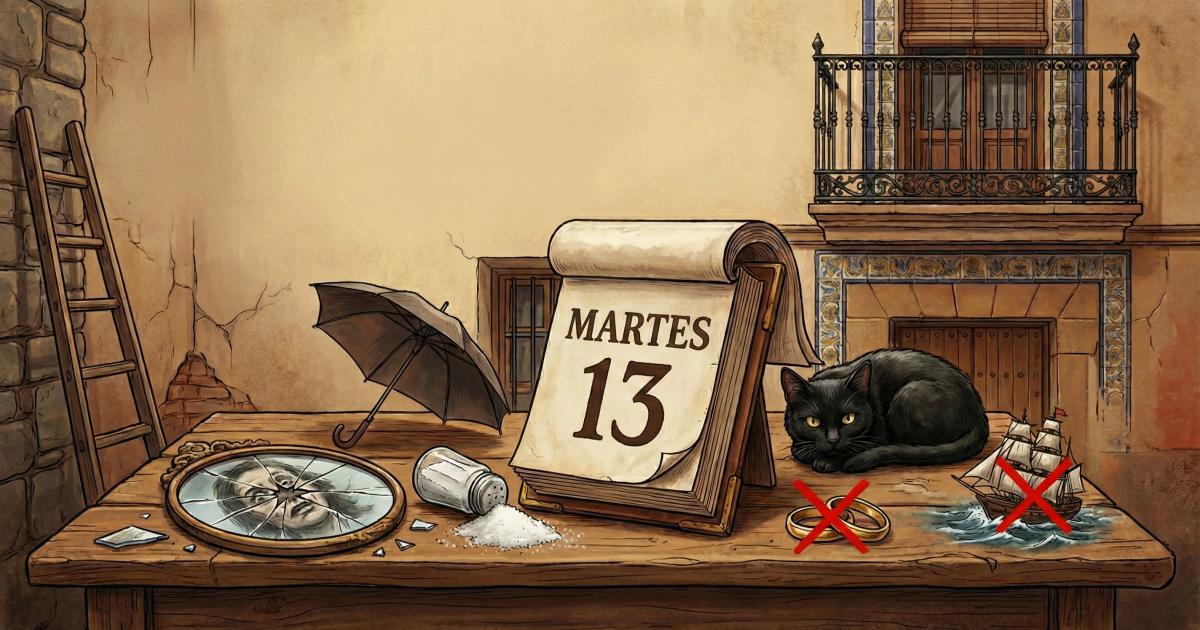
Tuesday the 13th: Why is it an unlucky day in Spain?
While in Poland and Anglo-Saxon countries we tremble before Friday the 13th, in Spain and many Latin American countries the calendar of fear looks a little different. There, the day to be feared is Tuesday the 13th.
A famous Spanish proverb warns: "En martes, ni te cases ni te embarques" (On Tuesday do not marry or go to sea). But where did this ominous fame come from, and why exactly is this combination of day and number so feared?
Genesis of unlucky Tuesday
As with most superstitions, the "bad fame" of Tuesday the 13th does not have one specific source. Its roots are lost in the darkness of history, mythology and religion.
1. Tuesday - a day of war and destruction
According to the Cervantes Institute, the key to understanding this fear is etymology. In Spanish, Tuesday is "martes", a word derived from the name of the Roman god of war - Mars.
- Mars in mythology was a symbol of destruction, blood and violence.
- Therefore, it was believed that the day dedicated to this deity was not suitable for starting important ventures, business or taking risks.
- Interestingly, also in Egyptian and Turkish culture, Tuesday was historically considered an unlucky day.
2. historic disasters
Spanish historians also point to specific events. There is a theory that the superstition was perpetuated because it was on Tuesdays that Christian armies suffered painful defeats in battles against the Moors.
3. The cursed number 13
The other half of this date - the number 13 - brings even more negative connotations to the calendar, mainly religious in nature:
- Last Supper: At the table sat 12 apostles and Jesus. The 13th person was Judas - the traitor.
- Kabbalah: In Jewish mysticism, 13 evil spirits are mentioned.
- Apocalypse: It is in the 13th chapter of the Apocalypse of St. John that the Antichrist appears.
Despite all these legends, it's worth remembering: there is no scientific evidence that proves that Tuesday the 13th (or Friday the 13th) is actually more unlucky than any other day of the year.
Spanish proverbs for Tuesday the 13th
Reactions to this date vary - some are paranoid, others approach it with humor. In Spanish there are many sayings related to this day. Here are the most popular ones along with a translation:
"Martes 13, ni te cases ni te embarques"(Tuesday the 13th, don't marry or go to sea) is the most famous warning.*
"En todas partes tiene cada semana su martes"(Everywhere, every week has its Tuesday) -which means that bad luck can get us anywhere.*
"Martes, ni te cases, ni te embarques, ni de tu familia te apartes"(Tuesday, do not marry, lunge or stray from your family)
"Para un hombre desgraciado, todos los días son martes"(For an unhappy man, every day is Tuesday)
"En martes, ni tela urdas ni tu hija cases; ni la lleves a confesar que no dirá la verdad"(On Tuesday, do not weave linen, do not give your daughter in marriage, or lead her to confession, for she will not tell the truth)
What NOT to do on Tuesday the 13th?
For the most superstitious Spaniards, the list of prohibitions is long. To avoid misfortune, the following should be avoided on this fateful day:
- Travel: Don't plan trips, and certainly don't sit in seat 13 on a plane or choose a flight with that number.
- Getting out of bed: Absolutely do not put your left foot on the floor first.
- Ladders: Never pass under an extended ladder.
- Meetings: Do not hold meetings or dinners for exactly 13 people.
- Mirrors: Be careful not to break the mirror (this risks as much as 7 years of misery).
- Salt: Do not spill salt.
- Money: Do not carry an empty wallet.
- Cats: Avoid black cats running across your path.
- Umbrella: Never open an umbrella inside a room.
- Shoes: Do not put new shoes on the table.
- Bread: Do not cut off both ends of the loaf of bread (tack).
- Tablecloth: Do not leave a white tablecloth on the table overnight.
Whether you believe in superstitions or take them with a pinch of salt, Tuesday the 13th is a fascinating part of Spanish folklore that has survived the centuries.