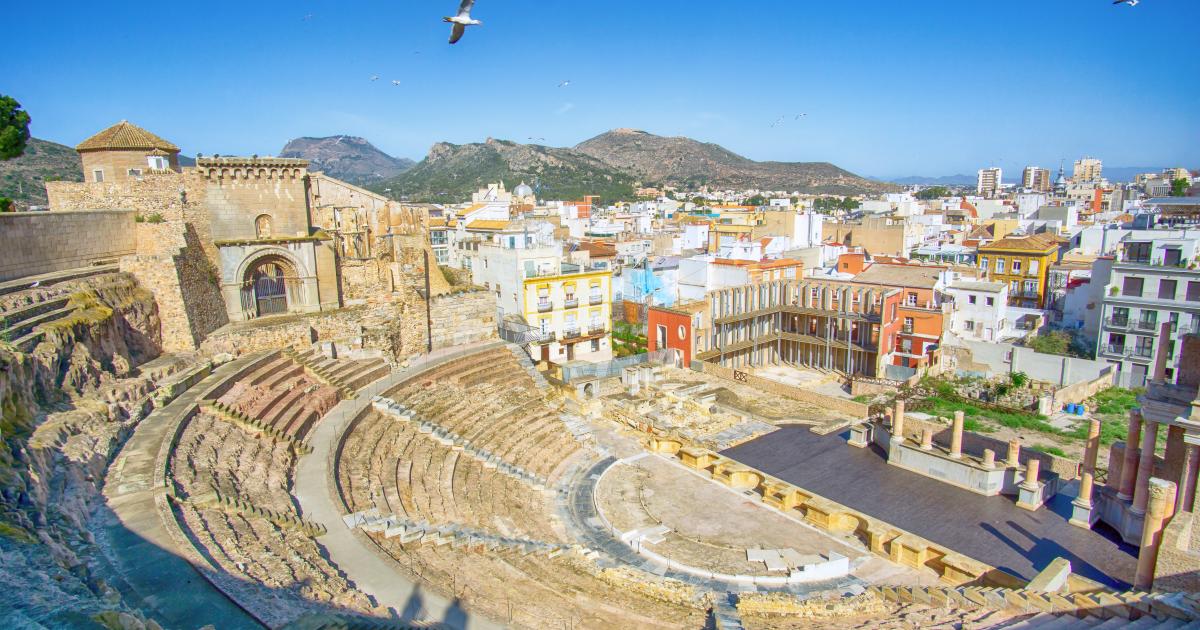
Cartagena and Murcia have joined the ranks of the 25 Spanish cities with the greatest economic freedom
Both municipalities in the region are notable for their restraint when it comes to economic interventionism, but their high tax burdens remain their Achilles’ heel.
Cartagena and Murcia are climbing the ranks and entering the “top 25” municipalities with the greatest economic freedom in Spain. This is according to the latest edition of the Index of Economic Freedom of Spanish Cities (ILECE), compiled by the Foundation for the Advancement of Liberty (Fundación para el Avance de la Libertad).
The report analyzed the fifty most populous cities in the country, evaluating four key areas of each city's operations:
- The municipality's economic performance (weighted at 32%)
- Fiscal pressure (32%)
- Number of employees in local government administration (18%)
- Economic interventionism by local authorities (18%)
For the first time, Castellón de la Plana topped the ranking with 75.5 points. This is also the highest score in the history of the ILECE index, which has been published since 2018. Rounding out the top three are neighboring Alicante (73.03 points) and Badajoz in Extremadura (70.21 points).
To find a city from the Region of Murcia, you have to look at the 20th position, which is held by Cartagena with a score of 59.43 points. Four spots further down, in 24th place, is Murcia (58.33 points). It should be noted, however, that over the past year, both municipalities have moved up in the rankings, and their level of economic freedom has been rated as “moderate.”
Thanks to the results from Cartagena and Murcia, the Region of Murcia itself is the eighth-highest-ranked autonomous community in the country, with an average of 58.88 points. The leader of the regional ranking is the Valencian Community (65.67 points), thanks to the excellent results of the aforementioned cities of Castellón and Alicante, as well as Elche (6th place nationally). All three of these cities are characterized by “satisfactory economic freedom.” Valencia itself, however, fared poorly in the ranking, coming in only 41st.
Cartagena: 20th Place and a Return to the Top
Cartagena, the 25th-largest city in Spain by population (222,559 residents according to the census), improved its score by four points and moved up six spots. As the authors of the study note, this increase “solidifies its position in the upper-middle range of the index” and confirms that it is one of the “most dynamic” cities in the Region of Murcia.
This rise is all the more significant given that as recently as 2025, the city recorded its worst ranking in history (26th place). This decline came just two years after reaching a historic high—in 2023, Cartagena ranked 10th with a score of 61.74 points.
The report commends the city’s efforts to reduce government intervention, but at the same time warns that taxes remain the main challenge. Attention was drawn to the construction tax (ICIO), set at the maximum level permitted by law (4%), and to the high per-capita tax revenue (829 euros).
Recommendations for Cartagena:
- Increasing the area's appeal to investors (the current density of businesses is low, at 50 per 1,000 residents).
- Reducing the tax burden to improve the region’s overall position and its ability to retain economic activity.
Murcia: 24th place and one of the best promotions in 2026
Murcia, Spain’s seventh-most populous city, recorded an impressive jump. Gaining more than seven points, it climbed as many as ten spots, which the report’s authors described as “one of the best climbs of 2026”. As a result, the city returns to the “upper-middle tier of the ILECE rankings after several years spent at the bottom of the table.”
The region’s capital, which ranked a high 13th in 2020, is currently most notable for its lack of excessive interventionism. Unfortunately, as in the case of Cartagena, fiscal policy is its weakest link.
The authors of the ranking point out that in Murcia, the construction tax (ICIO) is capped at 4%, the property tax (IBI) is high at 0.71%, the road tax (IVTM) hovers around the upper limit, and the paid parking zone (the so-called zona azul) is relatively expensive (1.15 euros).
Challenges Facing Murcia:
In addition to high taxes, the city has a very low business density (only 43 companies per 1,000 residents) and a relatively long payment period for suppliers, at 42 days. For this reason, experts believe that the key to maintaining the city’s growth trend will be, above all, reducing the tax burden and creating incentives for new businesses.