Does Spain Have Its Own Harvest Festival? A Comparison of Harvest Festival Traditions
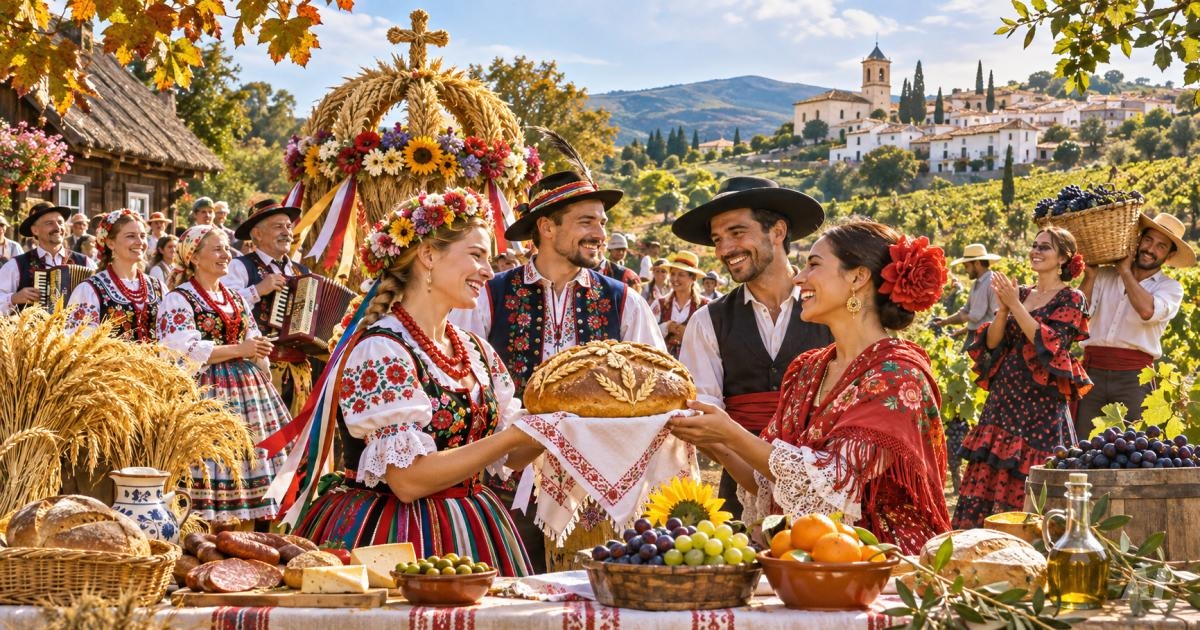
The Harvest Festival is one of the most deeply rooted celebrations in Polish folk culture. This celebration traditionally takes place in late August or early September, after the harvest is complete, and is an expression of gratitude for the harvest. In Poland, it is celebrated in both religious and secular contexts—often with the participation of local authorities, parishes, and the entire rural community. No harvest festival is complete without grain wreaths, a Mass of Thanksgiving, colorful parades, performances by folk ensembles, and refreshments featuring local delicacies.
Although harvest festivals are mainly associated with rural areas and agriculture, they are also an important part of Polish cultural identity—both within the country and among the Polish diaspora. In many regions of Poland, they take the form of large community festivals and even nationwide events attended by government officials.
Is there an equivalent of such a holiday in Spain? The answer is: not exactly. Although agriculture plays a huge role in Spain and rural culture has its own rich traditions, there is no single, common harvest festival here. Instead, Spain celebrates numerous regional festivals associated with the harvests of specific crops, such as grapes, olives, oranges, and apples.
One of the closest equivalents to the harvest festival is the Fiestas de la Vendimia, or grape harvest festivals. They take place in the fall in wine-producing regions such as La Rioja, Castile-La Mancha, Valencia, and Andalusia. They are secular and festive in nature—featuring parades, grape-stomping, young wine tastings, and concerts. It is a time of joy and celebration marking the end of the harvest, though without any direct religious reference.
Another example of a holiday related to agriculture is the celebration of Saint Isidore the Farmer (San Isidro Labrador), the patron saint of farmers. It falls on May 15 and is celebrated with particular fanfare in Madrid and the surrounding villages. On this day, farmers take part in processions, outdoor Masses are held, work tools and animals are blessed, and picnics and local fairs are organized.
Many smaller towns also host agricultural fairs and harvest festivals (ferias agrícolas, fiestas de la cosecha), during which local producers showcase their products, and municipalities organize folk dance performances, cooking contests, and exhibitions of agricultural machinery. Such events are deeply rooted in local calendars and vary by region and the main crops grown there.
Spain, as a country composed of 17 autonomous communities, is characterized by great cultural and climatic diversity. Therefore, there is no single, shared harvest festival tradition here, as there is in Poland. The celebrations are local in nature, and their form and date depend on the specific characteristics of each region.
It is worth noting, however, that just as in Poland, Spanish harvest festivals play an important social and cultural role—they bring residents together, promote local identity and products, and serve as a tourist attraction. They differ, however, in form: in Spain, parades, festivals, and product promotion dominate, while in Poland, greater emphasis is placed on tradition, symbolism, and gratitude for the harvest.