Spanish Absurdities Through the Eyes of a Pole
In other words, how not to lose your mind when you once again come across a door without a doorknob and dinner at 10:00 p.m.
Life in Spain can be beautiful—the sun is shining, the sea is lapping, and people are smiling. But every Pole who has settled here for the long term knows that, in addition to the delights, there are also… surprises. And sometimes even a quiet “What on earth is going on here?” Here’s a subjective overview of Spanish absurdities that regularly surprise us Poles—and, whether we like it or not, teach us humility.
1. Siesta – meaning you won't eat because everyone else is eating (or sleeping)
Imagine this: it’s the middle of the day, and you have a moment to run an errand. You go to a government office, a bank, or a store, and there… it’s closed. Because it’s siesta time—the sacred hour of the Spanish reset. And it’s not like everyone is actually sleeping. Some are sleeping, others are eating, and still others are looking at their phones, but one thing is certain—you won’t get anything done between 2:00 p.m. and 5:00 p.m.
For a Pole, who is used to “getting things done and moving on,” a siesta is an absurd hindrance to productivity. But after a few years… you might fall in love with this slower pace of life. Or at least come to accept it.
2. Individual Meals: So When Do You Actually Eat Them?
Dinner at 6:00 p.m. in Poland? Classic. In Spain? An assault on the freedom of the stomach! Here, lunch at 3:00 p.m. is the norm, and dinner at 10:00 p.m. doesn’t surprise anyone—especially in the summer. Kids running around playgrounds at 11:30 p.m. with ice cream in hand? Absolutely.
At first, the Poles ask, “So when do they actually work?”—but later on, they just try not to fall asleep at the table before the appetizer is served.
3. Word Truncation: “pelí, finde, profe” and Other Linguistic Puzzles
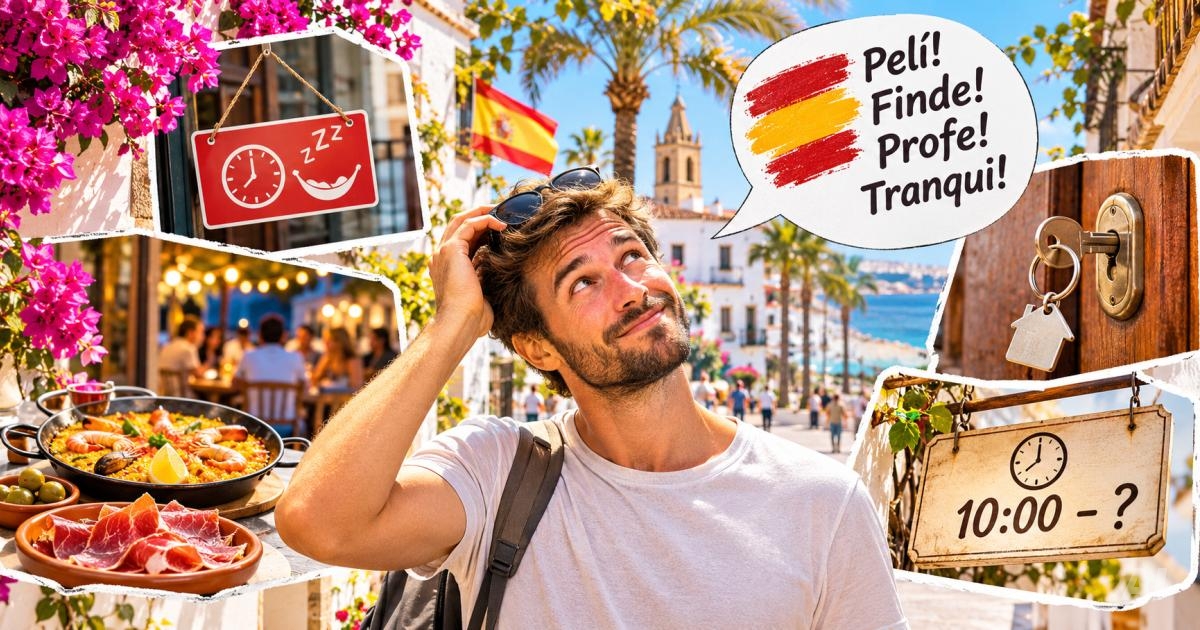
Spaniards love diminutives and abbreviations. “Película” becomes “pelí,” “fin de semana” is “finde,” “profesora” is “profe,” and “tranquilo” is simply “tranqui.” At first, it seems like they’re talking to children. Then it turns out that this is how the bank president and the family doctor speak.
For a Pole learning the language, it’s torture—because suddenly it turns out that they know a word but don’t recognize it. It’s as if someone had taken half their dictionary away and said, “Figure it out.”
4. Doors Without Door Handles—A Classic Example of Spanish Frustration Design
If you’re new here, you’re bound to go through this: you’re standing in front of a door and don’t know how to open it. You yank at it, push it, look for a doorknob that… doesn’t exist. Because Spaniards love doors with latches that can only be opened with a key—even from the inside. Sometimes, when you leave the house, you wonder if you’ll actually be able to get back in.
You get used to it over time. And you learn one rule: always, ALWAYS put your keys in your pocket. Even if you're just taking out the trash.
5. Hours of operation: Open from – to... whenever possible
Is the store open at 10:00 a.m.? In theory, yes. In practice, it might be 10:15 a.m., because Mrs. Maria is having coffee at her neighbor’s right now. The pharmacy? They’re on a break, even though there’s no sign on the door. The government office? They’re open on Wednesdays, but only until 1:30 p.m.—and only by prior online appointment, which nobody checks anyway.
For a Pole, it's organizational chaos; for a Spaniard, it's just normal life without any stress. We're not here to get stressed out.
And yet: we love this mess
Although at first all of this may seem strange, annoying, or even frustrating, over time we begin to understand that this “absurdity” is simply a different way of looking at life. Less orderly, more intuitive, sometimes chaotic, but... surprisingly human.
Because Spain isn’t Excel. It’s spontaneity, the rhythm of the heart, and the smile of the cashier who, instead of saying “Next!” tells you that you have beautiful eyes. And even though we sometimes dream of a doorknob or a pharmacy open on Monday at 9:00 a.m., it’s precisely these differences that give us stories to tell and things to laugh about—with a sense of perspective and affection.