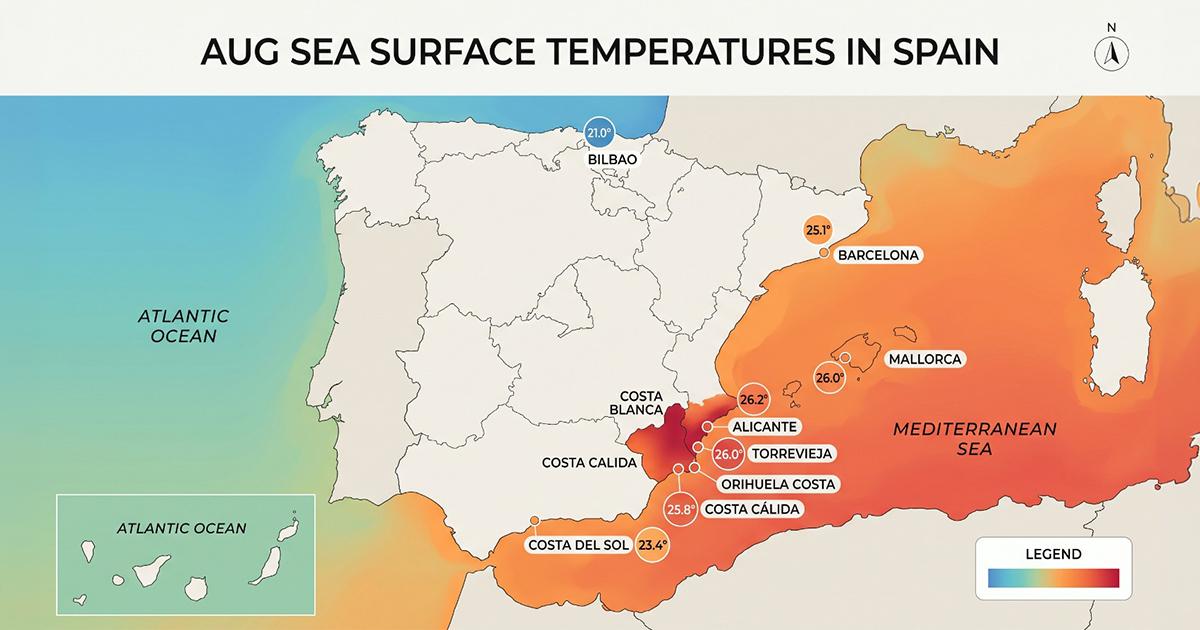
How warm is the sea in Spain right now? The Costa Blanca and Costa Cálida in the height of summer
In August, Alicante, Torrevieja, Orihuela Costa, and Costa Cálida are among the places where the Mediterranean Sea reaches its highest temperatures of the year. What’s the water temperature right now, and where can you expect the warmest swim?
August is not only the peak of the summer vacation season, but also the time when the Mediterranean Sea is exceptionally warm. After many weeks of intense sunshine, the water temperature along the southeastern coast of Spain remains at a level that many people consider ideal for swimming.
In the Alicante, Torrevieja, Orihuela Costa, and Costa Cálida regions, the water temperature in August is usually around 25–27°C. However, the exact temperature may vary depending on the location, depth, sunlight, wind, and current conditions.
Alicante – the sea is almost like a swimming pool
Alicante is one of the places on the Spanish coast where you can expect truly warm water in August. The average sea temperature this month is about 26.2°C, and the highest temperatures reach about 27.4°C.
This is the temperature at which entering the water does not cause the characteristic “thermal shock” for most people. The sea is pleasant for both a quick dip and a longer swim.
Importantly, the high water temperature doesn't end with August. In September, the sea in Alicante still stays around 25°C.
Torrevieja – about 26°C
In Torrevieja, the average sea temperature in August is around 26°C. It’s one of those times of year when the water is already quite warm, and even an evening swim doesn’t have to mean braving the cold.
For the residents of Torrevieja, this means a long swimming season. Even when air temperatures begin to drop slowly in September, the sea will still retain the heat it has accumulated over the summer.
Orihuela Costa – Similar Conditions
On the Orihuela Costa, the situation is very similar to that in Torrevieja. Both areas are located in the same part of Spain’s southeastern coast, so the differences in water temperature between neighboring beaches are usually minor.
In August, a temperature of about 26°C can be considered typical for this region.
Of course, individual beaches may vary slightly. Shallow, sheltered coves warm up faster than more exposed stretches of coastline. The wind, waves, and local coastal currents also affect the perceived temperature.
Costa Cálida – the name says it all
South of Orihuela Costa lies the region of Murcia and the Costa Cálida, or “Warm Coast.” The name is definitely no coincidence in August.
In the area around Cartagena, the average sea temperature in August is about 25.8°C, and during the warmest periods, it can exceed 27°C.
A particularly special place is, of course, Mar Menor—a shallow lagoon separated from the open Mediterranean Sea by the La Manga isthmus. Because the water is shallow, it can warm up faster than in the open sea.
This is one of the reasons why the Mar Menor has been attracting people looking for exceptionally warm and calmer waters for years.
What about the Costa del Sol?
Here's an interesting fact that might surprise people who are only looking at the map.
After all, the Costa del Sol is associated with the hot south of Spain, sunshine, and high temperatures. Meanwhile, the sea there is usually cooler in August than on the Costa Blanca.
The average water temperature on the Costa del Sol in August is about 23.4°C, with the highest temperatures reaching about 25°C.
By comparison, Alicante has an average temperature of about 26.2°C during the same month.
The difference can therefore be a few degrees—and it’s definitely noticeable while bathing.
This is a good example of how the warmest air doesn't always mean the warmest sea.
Why is the ocean so warm right now?
The sea needs time to warm up. In the spring, despite rising air temperatures, the water remains relatively cool. This changes in June, July, and August, when the sea’s surface receives a massive amount of solar energy over many weeks.
That is why the warmest water does not necessarily occur exactly when we record the highest air temperatures. The sea reacts with a certain delay.
This also explains why September can be a great month for going to the beach. The air is slowly starting to cool down, but the sea still retains the heat it absorbed during the summer.
Spain has a wide variety of “seas”
Although we're talking about a single country, water temperatures along Spain's various coastlines can vary significantly.
| Region | Average sea temperature in August |
|---|---|
| Alicante | approx. 26.2°C |
| Torrevieja | approx. 26°C |
| Orihuela Costa | approx. 26°C |
| Costa Cálida / Cartagena | approx. 25.8°C |
| Costa del Sol | approx. 23.4°C |
| Majorca | approx. 26°C |
| Barcelona | approx. 25.1°C |
| Tenerife | approx. 23°C |
| Bilbao | approx. 21°C |
These figures are approximate and may vary depending on the specific beach and current conditions. However, they show a clear difference between various parts of the Spanish coast.
The Costa Blanca's season doesn't end in August
For residents of Alicante, Torrevieja, and Orihuela Costa, the good news is that the warm sea temperatures don't end when the summer vacation is over.
September continues to offer very comfortable conditions for swimming. The sea remains warm, while the peak summer heat is slowly beginning to subside.
That is why many residents of the Costa Blanca consider September to be one of the best months for going to the beach. The beaches become less crowded, the air temperatures are more comfortable, but the sea still retains its summer warmth.
So what's the temperature of the sea right now?
In the second half of August, it's safe to assume that the water on the Costa Blanca and Costa Cálida is around 26°C, while on the Costa del Sol it's on average a few degrees cooler.
It’s the water temperature that makes the Mediterranean more than just a place for a quick dip for many people. You can get in the water, swim for a long time, and not have to spend a few minutes wondering if the water is the right temperature.
And as August gives way to September, the sea will still have plenty of summer warmth in store.