Bottle and Can Deposits in Spain: What Will Change and When?
When you buy water, beer, or a canned drink, you pay a few cents more, and you get your money back when you return the empty container to the store. Spain is preparing to implement a nationwide deposit-return system (SDDR). A specific date has been reported in the Spanish media: November 22, 2026. We looked into what the regulations actually say and what this change will mean in the daily lives of residents and citizens.
November 22, 2026 – Will the system go live then?
This date didn't come out of nowhere. According to EU and national requirements, Spain was supposed to reach a 70% rate of separate collection of single-use plastic beverage bottles by 2023. According to official data from the Ministry of Ecological Transition, only 41.3% was collected.
Spanish law (Royal Decree 1055/2022) explicitly stipulates that if the required threshold is not met, the government is required to establish a deposit, return, and collection system for packaging—abbreviated as SDDR (Sistema de Depósito, Devolución y Retorno). The regulations stipulate exactly two years from the publication of the official results to organize and launch the system. Hence the deadline: November 22, 2026.
There is, however, one important “but.” This is a deadline set by law, not a guarantee that on that exact day, vending machines will appear in all supermarkets across Spain and a deposit will begin to be charged at the checkout counters. Logistical and procurement preparations are experiencing delays, and building the infrastructure for the entire country is a massive operational challenge. As of today, therefore, it is impossible to say with 100 percent certainty that the system will launch simultaneously from Galicia to Andalusia on November 22.
One thing, however, is certain: Spain has no other choice and must introduce the bail system.
How will this work in practice?
The rule is the same as in other European countries that adopted this model years ago. When you buy a beverage in a container covered by the system, you’ll pay an additional deposit. After emptying the bottle, you won’t throw it away in the yellow bin, but will return it to a collection point—and get your deposit back.
How much will we pay?
Spanish regulations set the minimum deposit at 10 cents per container (the final amount set by the operator may be higher, e.g., 20 cents). So, if we buy a six-pack of soft drinks or beer with a 10-cent deposit per item, the total at the register will increase by 60 cents. We’ll get all that money back when we return the containers.
Will I need a receipt for the refund?
No. You won't have to keep receipts from every purchase or remember which store you bought a particular drink at.
The system is based on barcodes and special SDDR graphic markings. What counts is the packaging itself—which is introduced to the market as part of the system—and ensuring it remains legible, not a paper proof of purchase.
Can we return a bottle purchased at one store to another store?
As a general rule—yes. The system is designed to be universal: empty bottles can be returned at any retail location participating in the return network, not just where they were purchased.
It is worth remembering, however, that the regulations allow for differences in obligations depending on the size of the store. While large supermarkets will be required to accept all standard packaging, simplified collection rules may apply to small, neighborhood stores.
Where will we return our bottles and cans?
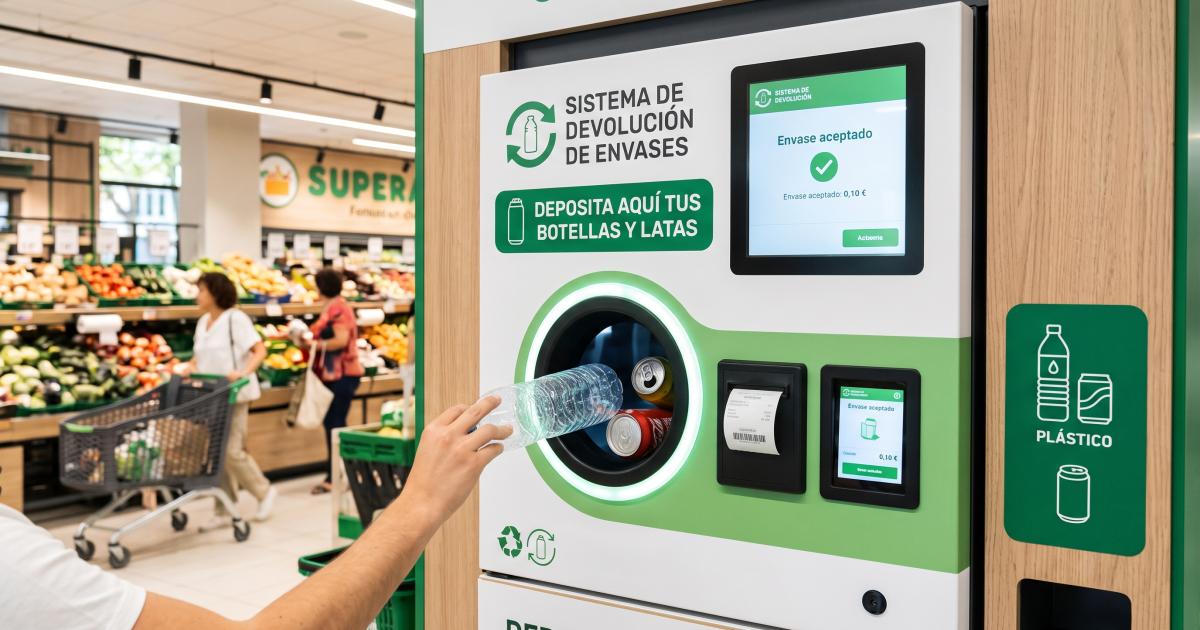
The most noticeable change in retail spaces will be packaging collection machines (known as Reverse Vending Machines), which are very well known in Germany and Scandinavia.
However, machines won’t be the only solution. Spanish law allows for both automated collection and manual collection at the register. In smaller stores, we’ll hand the bottles directly to the clerk, who will deduct the deposit from our current purchases or give us cash.
What will be covered by the security deposit?
The new mechanism will focus on beverages sold in single-use containers with a capacity of up to 3 liters:
- Plastic bottles (PET) that once contained water, juices, nectars, carbonated beverages, or sports drinks.
- Metal cans (aluminum and steel) from soft drinks and beer.
- Ultimately, selected multi-material cartons (such as brick cartons) for beverages, although their implementation may take place in phases.
Contrary to common misconceptions, the deposit system will not apply to all plastic products. Laundry detergents, shampoos, jars that once held preserves, and cardboard boxes that once held household cleaning products will still be subject to the old rules.
Will it be allowed to crush bottles and cans?
This is where you'll have to change some long-standing habits. If the package is to be placed in the machine, the machine must scan it, check its shape and weight, and read the barcode.
A crushed bottle or can with a damaged label will simply be rejected by the machine. This doesn’t mean you should panic over every little dent, but the rule is simple: the better the shape and the more legible the code, the more certain you can be of getting your money back.
What about the yellow bins on the streets?
The yellow recycling bins (contenedores amarillos) will not disappear from Spanish neighborhoods. They will continue to be used for disposing of plastic wrap, yogurt cups, Styrofoam trays, household cleaning product packaging, and other plastic and metal waste not subject to a deposit.
The only thing that will change is that throwing a water bottle or a cola can into the yellow bin will literally be like throwing a dozen or so cents into the trash.
Is it worth starting to save empty bottles in the garage now?
Definitely no. If you've just started looking at that bag of cans sitting in the corner as the seed of your retirement fund—it's time to throw it away.
We will only receive a refund for those bottles and cans that enter the market after the system is launched, bear the official SDDR label, and for which we actually paid the deposit at the time of purchase. Today’s packaging will not suddenly acquire some magical value.
What's worth remembering?
- The obligation is a foregone conclusion: The deposit-refund system in Spain is no longer just a tentative proposal or a topic for discussion—the need to implement it stems directly from Spanish law following the failure of the previous collection model.
- Minimum rate: The deposit will be at least 10 cents per item, which—for packs or multipacks of beverages—will already be a noticeable item on the receipt.
- Refunds without receipts: You won't need a receipt or to return to the same store to get your deposit back.
- A date to keep in mind: November 22, 2026, is the official deadline set by law, not a guarantee that the machines will be up and running in every store in the country on that date. Preparations are underway, and we will keep you updated on the actual launch date and the readiness of retail chains.