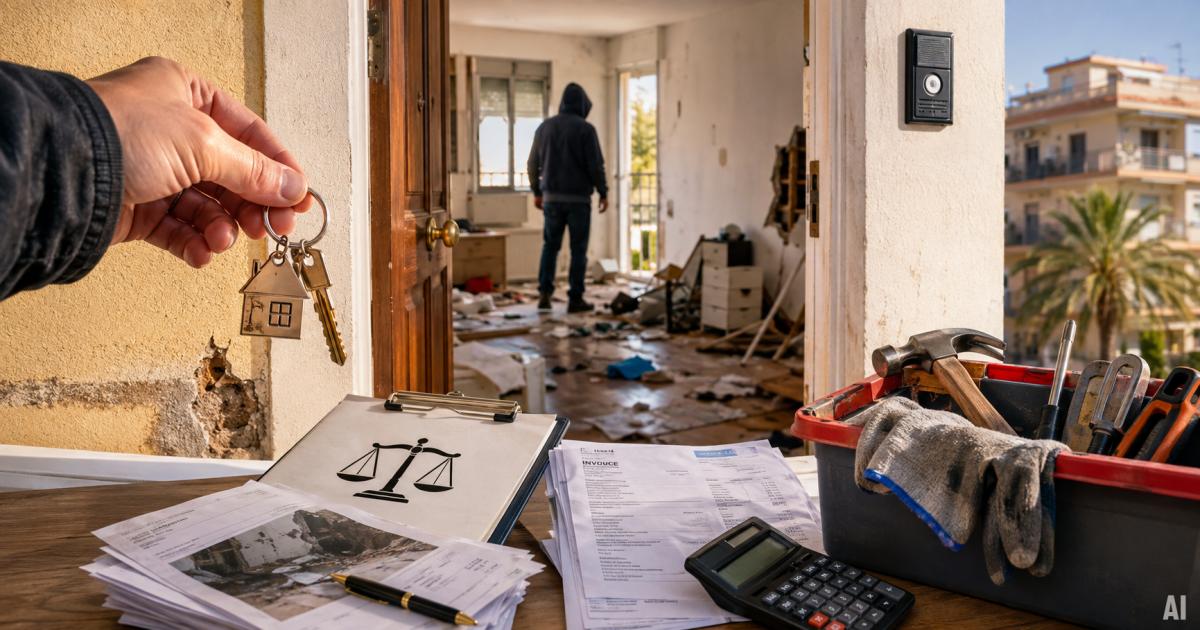
Have squatters taken over your apartment? The Generalitat is providing owners with up to 2,000 euros to combat illegal occupation
Homeowners in the Valencian Community who have been victims of illegal property occupation may apply for financial assistance to reclaim their homes and repair the damage. The Generalitat Valenciana has initially allocated 250,000 euros to the program, and the budget may be increased. The maximum amount of aid per beneficiary is 2,000 euros. There is little time left to submit an application—the application period runs through September 10, 2026.
The issue of “ocupación ilegal”—that is, the illegal occupation of real estate—has been a highly contentious topic in Spain for years. For the apartment owner, however, it is not merely a legal issue. In many cases, there are also costs associated with legal representation and paperwork, and once the property is recovered—bills for cleaning, replacing locks, doors, and plumbing, or repairing other damage.
It was precisely to cover some of these expenses that the Generalitat Valenciana launched a special aid program in 2026.
Up to 2,000 euros per property
The program provides for two basic types of expenditures.
Up to 500 euros can be allocated for professional legal advice related to regaining possession of real estate or having it vacated.
An additional up to 1,500 euros may be allocated to repair damage caused to the apartment as a result of the illegal occupation.
In total, this means that up to 2,000 euros per beneficiary can be obtained. However, this is not an automatic payment—the amount of aid granted depends on the costs actually incurred and properly documented. The program’s official guidelines also state that expenses must be supported by invoices or equivalent documents.
Who is eligible to receive the money?
The program is intended for individuals who meet certain criteria.
Among other things, the beneficiary must:
- be the owner or usufructuary of real property located in the Comunitat Valenciana,
- have had administrative residence in the Valencian Community for at least one year prior to submitting the application,
- hold the required residence status or citizenship in accordance with the program’s rules,
- prove that the property was seized without proper legal title or that the situation became unlawful as a result of a breach of contract.
In the case of foreign nationals who are not citizens of the EU/EEA or Switzerland, they must also be residing in Spain legally, subject to the exceptions provided for by law.
This is particularly important information for Poles living on the Costa Blanca. Simply owning an apartment in Spain is not enough. One of the requirements is, in fact, a properly documented vecindad administrativa in the region.
“Okupas” — but the regulations also cover certain disputes with tenants
It’s worth noting a detail that might be overlooked when using the common term “okupas.”
The program’s official guidelines define unlawful occupation not only as entering a residence without any legal basis. Assistance may also apply to situations in which the occupation becomes unlawful due to a breach of contract.
In such a case, the owner must properly document the violation, including through formal demands for payment or documentation related to the proceedings.
This means that the program is not intended solely for the most common scenario: someone enters an empty apartment and remains there without the owner's permission.
What needs to be proven?
The administration will not disburse funds based solely on a statement from the owner.
In the case of unlawful seizure without legal title, it is necessary, among other things, to demonstrate that the owner took appropriate action—for example, filed a report with the police or notified the competent judicial authority. The regulations also provide for the possibility of using a police report regarding the unlawful seizure.
The owner should therefore keep all documentation related to the matter.
This applies primarily to:
- documents proving ownership or usufruct,
- court notices or court documents,
- bills and invoices for legal services,
- invoices for repairs performed,
- documentation confirming the damage incurred.
Not every renovation will be funded
There is also an important limitation here.
The grant is not intended for a complete renovation of the apartment.
The program covers repairs for damage caused by the illegal occupation of the property. Therefore, the 1,500 euros cannot be treated as a subsidy for routine renovations, bathroom upgrades, or kitchen replacements simply because the apartment was previously occupied.
Excluded from the program are, among other things, the costs of the court proceedings themselves, as well as modernization or rehabilitation work that is not directly related to the damage caused by the seizure.
It's the order of the applications that counts
This is one of the most important points for people who plan to participate in the program.
Aid is awarded on a competitive basis, and the primary criterion is the date a complete application is submitted. In practice, this means a “first-come, first-served” principle—until the available funds are exhausted.
If the budget is exhausted, simply meeting the conditions will not automatically result in receiving the funds.
That is why waiting until the last few days to submit your application can be risky.
Date: September 10, 2026
The current call for applications allows for the submission of proposals through September 10, 2026.
According to information regarding the program’s launch, the initial funding pool amounts to 250,000 euros, with the possibility of an increase. The Generalitat has announced an increase in funding for this initiative, which could raise the program’s total budget.
For owners, this means one thing: it's not worth waiting until the last day.
What expenses does the assistance cover?
In a nutshell:
| Type of Expenditure | Maximum Assistance |
|---|---|
| Legal advice regarding the recovery of an apartment | 500 € |
| Repair of damage caused by seizure | €1,500 |
| Total | up to €2,000 |
These amounts are derived directly from the program's governing principles.
Important Notice for Property Owners on the Costa Blanca
For Polish property owners in Torrevieja, Orihuela Costa, Guardamar, Santa Pola, Alicante, or other towns in the Valencian Community, one detail is of the utmost importance: owning a property in the region is not the same as meeting all the program’s requirements.
Among other things, the requirement of at least one year of administrative residency is of key importance.
Therefore, before submitting your documents, it’s a good idea to carefully review your situation and make sure you have all the required attachments.
The Generalitat is providing funding for areas where the owner had previously covered the costs on their own
The new assistance does not solve the problem of squatting and does not guarantee the prompt recovery of the apartment. However, it does provide concrete financial support to people who have already found themselves in this situation.
Up to 500 euros for legal assistance and up to 1,500 euros for damage repair may not cover all expenses, but for a homeowner who has just regained possession of a damaged apartment, every reimbursement matters.
The most important date is September 10, 2026. Applications must be complete, and funding is limited.
This article is for informational purposes only and does not constitute legal advice. If you have a specific case involving the unlawful seizure of real estate, it is advisable to consult a lawyer in Spain.