Polish Easter palms: a tradition higher than a church steeple!
Palm Sunday opens Holy Week and is one of the most colorful days in the Polish calendar. This is the day when Poles bring palms - decorative compositions of twigs and flowers - to churches. For Poles living in Spain, it's a great opportunity to show their children one of the most beautiful Polish traditions - and make their own palms even thousands of kilometers away from their homeland!
Where did Polish palm trees come from?
In Poland, the tradition of Easter palms dates back to the 11th century. But why "palms" when no real palms grow in Poland? Palms are created from willow stems, since willow is the tree that awakens to life earliest in spring. In old Polish culture, willow was considered a "life-loving" plant, as it was the first to bloom in spring and grow even in the harshest conditions. Traditional Easter palms in Poland were made mainly of willow stems with basil - those soft, silvery "catkins" that appear in early spring.
Every region has its own palm tree!
Depending on the region, palms differ in appearance and technique of making. This is a real map of Polish cultural diversity! Here are the most interesting varieties:
- the Kurpie palm - is made from the trunk of a cut tree (fir or spruce), entwined along its length with pitchfork, heather, bilberry, decorated with tissue paper flowers and ribbons. Since 1969, a competition for the most beautiful traditional Kurpie palm has been held in the village of Łyse in Kurpie. The ornaments usually measure about 10 meters.
- the Vilnius palm tree - a true masterpiece! Colorful and decorative Vilnius palms are braided from 50 species of dry field, forest and garden flowers harvested at different times of the year for the right colors.
- the Silesian Palm - completely different from the others. It is not large or decorated with tissue paper. It consists of five or seven species of trees or shrubs, at least one of which should contain thorns. The characteristic element is the red willow.
- Mountain Palm - made from a bundle of willow, wicker or hazel vitae, as well as boxwood and juniper.
- the Petal Palm - consists of water reeds, blueberries, willow basil, small tissue paper flowers in bright colors - all arranged in a bouquet.
Lipnica Murowana - the capital of giant palm trees!
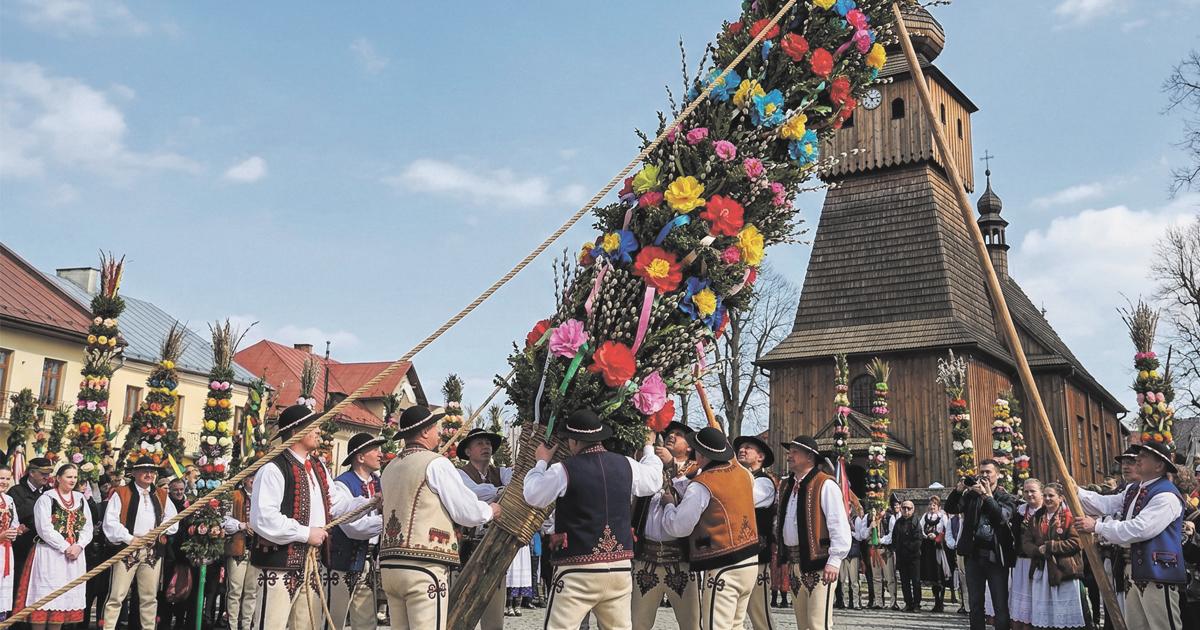
If there is one place in Poland that has taken Easter palms to the level of an absolute record, it is Lipnica Murowana in Malopolska. In 1958, Jozef Piotrowski - a community activist, poet and great lover of Lipnica - wanting to preserve the then vanishing tradition of palm making, initiated and organized the first Lipnica Palm Competition. Today the event is a nationally recognized brand of the municipality and is a showcase of Polish folk craftsmanship.
The record: almost 38 meters! The tallest palm tree in the history of the competition - measuring 37 meters and 78 centimeters - was made in 2019 by Andrzej Goryl, then a 21-year-old resident of Lipnica Górna. It is the height of a 12-story apartment block! In addition to his passion for palm trees, the young artist is interested in automobiles, is a firefighter for the Volunteer Fire Department, works for a construction company and helps his family on the farm. The record-breaking result has brought him nationwide recognition.
But how is this possible? Traditional Lipnica palms are made exclusively from natural materials. The trunk of the palm is wicker, which is also used to tie the carefully arranged rods. The palm is decorated with colorful flowers and ribbons of tissue paper, bases and evergreens, and is topped with a bundle of pond grass. According to tradition, the palm tree must fit in the hands of the performer and be erected solely by the power of human hands. No wire, nails or plastic strings can be used to build the palm tree. The palm must be erected vertically by the force of human hands using only ropes and stabilizing poles, without the use of cranes or hoists. Imagine - almost 38 meters put up by hand!
Interesting fact: how many morgas of land, so many meters of palm tree! The palm tree was an important symbol of a farmer's wealth and social status - its height depended on the size of the farm. It was said that "how many morgas of land, so many meters of palm tree". And in the 1960s an amusing incident occurred: to this day an anecdote is remembered with a smile, when the competition stirred up a controversy with the then parish priest of Lipnice, Rev. Jan Sarna. The clergyman was not happy about bringing very tall palms into the church - they covered the pulpit and reached the chandeliers hanging from the ceiling!
Traditional folk beliefs
In old Polish folk culture, the palm had a special meaning beyond religion - it was part of agricultural rituals and spring customs: - Villagers ate "willow catkins" in the spring, believing them to have a beneficial effect on health. - In Pomerania and Kashubia, fishermen tied a piece of palm branch to their nets as a talisman of happy fishing. - In southern Poland, Easter palms were used to make ornaments for the field, and on Easter Monday small crosses made from palms were hammered into the farmland with the intention of a good harvest. - The consecrated branches were flogged to each other - symbolizing the rebirth of nature and life.
Material published with the financial support of the Consulate General of the Republic of Poland in Barcelona