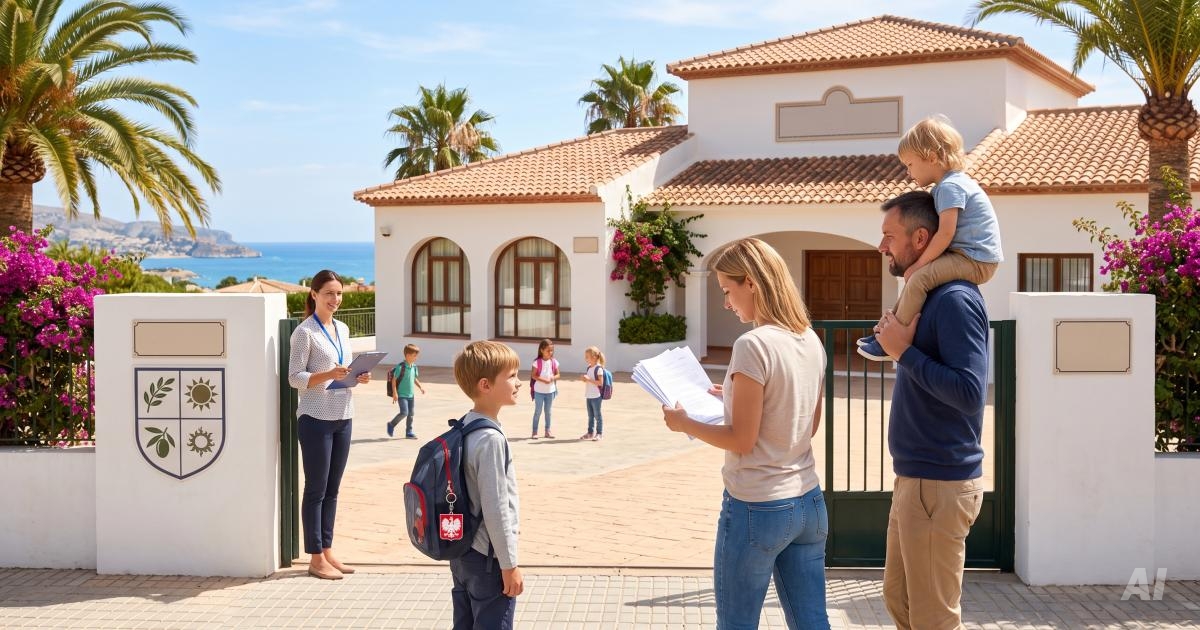
Back to School in Spain: What Should Polish Parents Know?
For thousands of families living in Spain, September marks a return to the daily routine of school. For Polish parents, especially those who have recently moved to the Costa Blanca, the Spanish education system may, however, involve many new rules, deadlines, and formalities. What is schooling like in Spain, when does the school year begin, and what should you do if your child wasn’t enrolled in school by the deadline?
The Spanish School System—What Is It Like?
The Spanish education system consists of several basic stages. Educación Infantil, or early childhood education, covers children up to age 6. The second cycle, for children ages 3 to 6, is free in public schools.
This is followed by Educación Primaria, a six-year elementary school program that typically covers children aged 6 to 12.
The next stage is ESO – Educación Secundaria Obligatoria. This is a four-year stage of compulsory secondary education, generally intended for students aged 12 to 16.
After completing ESO, students can continue their education, for example, in the two-year Bachillerato program, which prepares them for higher education, or choose Formación Profesional (FP), or vocational training.
When does the school year start?
The exact start and end dates of the school year are set by the autonomous communities. Therefore, the calendar may vary between Valencia, Murcia, Andalusia, and Madrid.
In the Comunitat Valenciana, for the 2026–2027 school year, classes in Educación Infantil, Primaria, ESO, and Bachillerato will begin on September 9, 2026, and end on June 18, 2027.
Throughout the year, students have breaks for Christmas and Easter, among other occasions, as well as days off for national, regional, and local holidays. Therefore, not all days off are the same throughout Spain.
School Enrollment – Deadlines Are Key
Standard enrollment in public and publicly funded schools takes place on dates set by the respective autonomous community.
In the Comunitat Valenciana, the main enrollment process for the 2026–2027 school year took place in the spring. However, this does not mean that families who were unable to submit their applications by that deadline must wait until next year.
Didn't get a chance to enroll your child in May or June? It's not too late
This information is particularly important for families who have just moved to Spain or who, for other reasons, did not participate in the initial enrollment process.
In the Valencian Community, there are procedures in place for emergency enrollment, which refers to the admission of students outside the regular enrollment period. These may apply, among other cases, to families who have moved to the region, students needing a spot during the school year, or situations in which a child was not admitted through the regular admission process.
This means that submitting an application late does not automatically mean you will lose the opportunity to enroll your child in school. However, your child’s assignment to a specific school depends on the applicable procedures and the availability of openings.
Parents who find themselves in this situation should contact the relevant authority responsible for escolarización in their place of residence as soon as possible and check for available spots in schools.
It's not worth waiting until the first day of school. The sooner a family starts the process, the easier it is to determine where the child can be admitted.
What documents should you prepare?
Parents moving their child from Poland should prepare the basic documentation that may be required during the admission process.
Depending on the situation and the requirements of a particular school district or school, the following may be needed, among other things:
- identification documents for the child and the parents,
- a document confirming your residential address,
- documentation regarding previous education,
- most recent report card or certificate from a school in Poland,
- documents required by a specific institution,
- in certain situations, medical records as well.
It's a good idea to get your documents from Poland ready before you move and keep both the originals and copies.
What about a certificate from Poland?
If a child is continuing the education they began in Poland, it is a good idea to keep their report cards and other documentation of their education to date.
For older students, especially those transitioning to the next stages of their education, it may be necessary to undergo a procedure for the homologación or convalidación of their prior education.
These are the formal procedures for recognizing or validating foreign educational qualifications in Spain. Their application depends, among other factors, on the level of education, the student’s age, and the stage of education to be pursued.
For younger children attending elementary school, the process is usually simpler. Parents of older students, however, should check well in advance whether formal recognition of their children’s prior education will be necessary.
It's not worth waiting until the last minute, especially if your child is finishing one stage of their education in Poland and is set to begin the next one in Spain.
Is public school free?
Education in public schools is free, but the start of the school year may involve additional expenses—including some school supplies, equipment, extracurricular activities, and certain services.
The Banc de Llibres Program operates in the Comunitat Valenciana; it is a system for borrowing and reusing textbooks and educational materials.
Parents should ask the school whether it participates in the program and what rules apply to students.
If your child is enrolled in school outside the standard enrollment period, you should contact the school office (secretaría) right away to ask whether your child can be enrolled in the Banc de Llibres program and, if so, under what conditions.
A school on the Costa Blanca offers more than just Spanish
Language is a very important issue for Polish families.
In the Valencian Community, in addition to Spanish, Valencian is also spoken. Its presence in education depends, among other things, on the language program of the specific school.
Therefore, when choosing a school, parents should find out in which languages classes are taught and what language program the school offers.
For a child arriving from Poland, this sometimes means having to adapt not to one, but to two languages used in the school environment.
What if the child doesn't speak Spanish?
The language barrier is one of the biggest challenges for children who come to Spain without knowing the language.
The way support is provided depends on the school, the child’s age, the child’s needs, and the available resources. Therefore, one should not assume that every school offers the same language program for foreign children.
In practice, the parents’ first contact with the school is very important. It’s a good idea to inform the teachers about the child’s previous education, language skills, and any potential challenges. This helps ensure a smoother transition.
The pace of language learning varies from person to person. Younger children often begin communicating with their peers relatively quickly, but it may take much longer for them to fully master the language needed to study academic subjects.
Are Spanish schools different from Polish schools?
Yes—and the differences can be noticeable both in the day-to-day operations of the school and in the way classes are conducted.
The modern education system in Spain places great emphasis on student competencies, the practical application of knowledge, active learning, and the development of various skills.
However, this does not mean that Spanish schools do not have quizzes, tests, or traditional grades. Their format and significance may vary depending on the stage of education and the specific school.
For a child accustomed to the Polish system, other aspects—such as a different daily schedule, the way teachers communicate with parents, or a greater emphasis on group work and projects—may also be new.
Extracurricular Activities and Supervision
In addition to required classes, schools may offer extracurricular activities—including sports, language, music, and art classes.
Some activities may be organized in cooperation with AMPA, the parents' association. However, the offerings, schedules, and prices for these activities depend on the specific school.
The same applies to before- and after-school care. Some schools offer morning or afternoon care options, which can be a great help to working parents. It’s a good idea to check the availability of such services directly with the school of your choice.
The First Few Weeks Are the Most Important
Starting school in a new country is a big change for a child. A new language, teachers, classmates, curriculum, and the way the school operates can be stressful at first.
That is why it is important to stay in regular contact with teachers, attend parent-teacher meetings, and address any problems as soon as they arise. It is especially important for children to have the opportunity to socialize with their peers outside of class as well.
For many Polish families, school becomes one of the first places where they truly begin to get to know the local community.
What Matters Most to Parents
If your child is going to start school in Spain, it’s important to keep a few basic rules in mind:
Check the deadlines that apply in your autonomous community. Spain does not have a single admissions calendar for all regions.
Don't wait if you didn't submit your application by the deadline. After the main enrollment period ends, there may be procedures for admitting students outside the regular deadline.
Gather your documents from Poland. This is especially important for older children who are continuing their education at the higher level.
Check the language of instruction. On the Costa Blanca, not only Spanish plays an important role, but also Valencian, depending on the school.
Ask about Banc de Llibres, extracurricular activities, and childcare. These issues can significantly impact a family’s daily life.
Stay in touch with the school. During the first few months, good communication between parents and teachers can make it much easier for your child to adjust.
School Is the Start of a New Life
For a Polish child, a Spanish school can be not only a place to gain knowledge, but also the first step toward learning the language, culture, and local community.
For parents, however, when their child transfers to a Spanish school, it means they have to learn new procedures and get used to a different educational system.
The most important thing, however, is to not be afraid to ask questions and not put off the paperwork until later. Even if the initial enrollment deadline has passed, that doesn't automatically mean your child has no chance of attending school.
If you’ve just moved to the Costa Blanca or your child still doesn’t have a spot in school for the 2026–2027 school year—take action as soon as possible. The Spanish education system has procedures in place for situations like this as well.