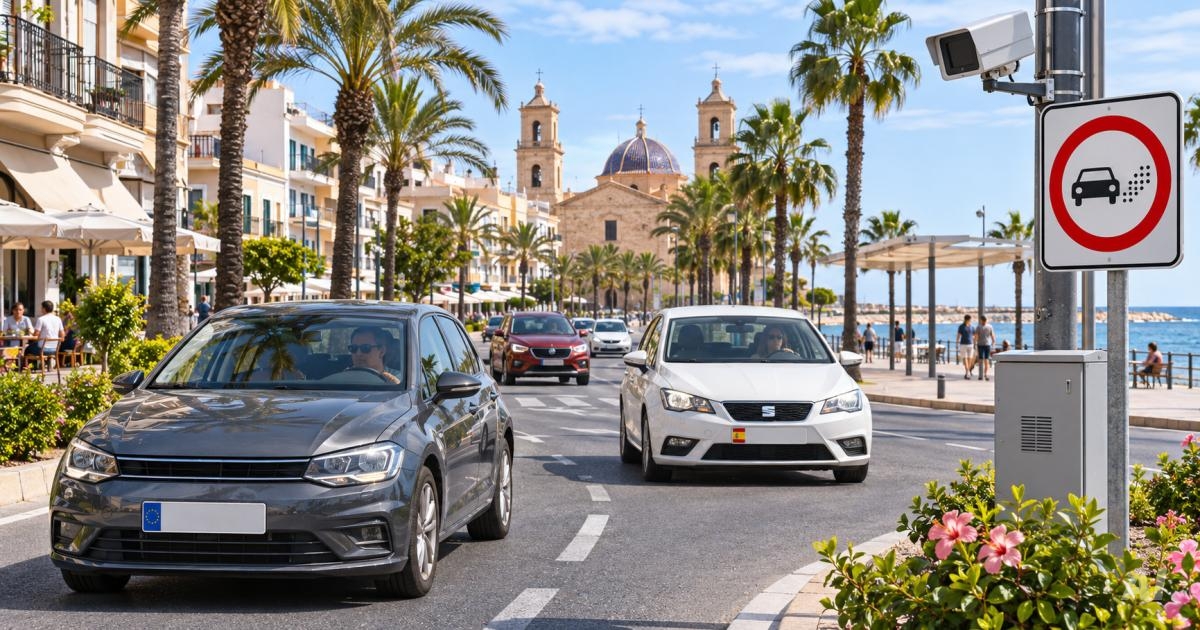
Torrevieja is postponing the issuance of fines in the Low-Emission Zone. What about cars with Polish and other foreign license plates?
The Torrevieja authorities have denied reports that fines would be imposed starting January 1, 2027, for non-compliance with the restrictions in effect in the Low-Emission Zone (LEZ). However, its future implementation raises many questions, particularly among foreign tourists, property owners on the Costa Blanca, and permanent residents of Spain who drive vehicles registered abroad.
Torrevieja authorities are reassuring drivers following reports that fines for violating the Low Emission Zone regulations (Spanish: Zona de Bajas Emisiones, abbreviated as ZBE) starting January 1, 2027.
According to information provided on November 27, 2026, by city officials and published by the website El Periòdic, the local government is still in the process of purchasing the equipment necessary to launch the vehicle inspection system. At the same time, the possibility of changing the deadlines specified in the current municipal regulations is being analyzed.
However, this does not mean that Torrevieja is abandoning plans to establish a Low-Emission Zone. Its full implementation will be postponed compared to the originally adopted schedule.
This information is particularly important for the large foreign community living on the Costa Blanca, including Poles, British, Germans, French, and citizens of other countries who drive cars registered in their home countries.
Unlike vehicles with Spanish license plates, foreign cars are not typically listed in the national database of the Spanish General Directorate of (DGT), which may cause additional difficulties in confirming their environmental classification.
When will the Low-Emission Zone in Torrevieja go into effect?
The final version of the regulations governing the operation of the Low-Emission Zone was adopted by the city council on December 22, 2025, and subsequently published on December 30, 2025, in the Official Gazette of the Province of Alicante (BOP), Issue No. 248.
According to the official text of the municipal regulations, the original schedule called for two phases of implementing the restrictions:
- January 1, 2027 – Restrictions take effect in Zone 1, which covers the central part of the city.
- January 1, 2029 – Extension of the restrictions to the second zone.
However, the latest statement from the Torrevieja authorities rules out the possibility of beginning to issue fines on the first of the dates mentioned.
As of the date this article was written, no officially published amendment to the regulations setting out a new schedule had been found. This means that although the city has announced it will not issue fines starting January 1, 2027, we still do not know the new date for the system’s full launch.
Why Does Torrevieja Need to Establish a Low-Emission Zone?
The requirement to establish low-emission zones stems from Spain’s Law 7/2021 on Climate Change and Energy Transition, which, among other things, requires cities with more than 50,000 residents to implement such measures.
The purpose of these zones is to reduce air pollution, improve air quality, cut emissions of harmful substances from road traffic, and promote more environmentally friendly modes of transportation.
However, each local government sets its own rules for the operation of the zone, the scope of restrictions, exceptions, and administrative procedures.
This means that a car authorized to enter the low-emission zone in Alicante, Barcelona, or Madrid will not necessarily be subject to the same rules in Torrevieja.
The model adopted by Torrevieja provides for numerous exceptions that take into account the needs of residents, business owners, employees, and the city’s status as a tourist destination.
For more information about the project, visit the Torrevieja City Hall's official website.
Which areas of Torrevieja will be subject to restrictions?
The Low-Emission Zone will not cover the entire territory of Torrevieja. It will primarily be concentrated around the city center, particularly in areas with heavy traffic and high levels of commercial, residential, and tourist activity.
The first phase will cover a significant portion of the city center, while the second phase calls for expanding the zone's boundaries to include neighboring areas.
Entrances to the zone will be clearly marked, and vehicles will be monitored using cameras and automatic license plate recognition systems.
The exact boundaries of both zones can be viewed on the map included in the official municipal regulations regarding the ZBE.
Cars with foreign license plates—will they be allowed to drive in Torrevieja?
Ownership of a car registered in Poland or another country will not, in and of itself, constitute grounds for denying entry into the Low-Emission Zone.
Environmental criteria are based on a vehicle's technical specifications, fuel type, propulsion system, and emission levels, rather than on the owner's nationality or the country where the vehicle is registered.
However, there is a significant administrative difference. For cars registered in Spain, information regarding their environmental classification is stored in the DGT database. For foreign vehicles, the municipal system will need a way to identify and verify their environmental category.
A modern car registered in Poland may meet exactly the same emissions requirements as an identical car registered in Spain. The difference lies in how this fact is documented.
Can you buy a Spanish environmental sticker for a car with Polish license plates?
No. The Spanish General Directorate of Traffic clearly states that it is not possible to issue Spanish environmental stickers (distintivo ambiental) for vehicles with foreign license plates.
This means that a Polish tourist arriving in Torrevieja in his or her own car cannot go to a Correos post office and purchase a DGT environmental sticker, even if his or her vehicle meets all the technical requirements necessary to obtain it.
The DGT recognizes the equivalents of the environmental classifications used in certain European countries, including Germany, Austria, Denmark, and France.
Vehicles bearing recognized environmental labels can demonstrate their compliance with the corresponding Spanish categories.
In the case of Poland, however, the DGT does not publish a separate table of equivalents for Polish environmental designations. Therefore, it may be particularly important to have technical documentation confirming the vehicle’s emissions standard.
Detailed information and the rules for recognizing foreign designations are available at the DGT’s official website and on the Spanish public administration portal.
Will cars with foreign license plates have to be registered in Torrevieja's municipal system?
This is one of the most important issues that still needs to be clarified by city officials.
The third transitional provision of the municipal regulation on the Low-Emission Zone refers directly to the municipal registry of foreign vehicles and other vehicles authorized to enter the zone.
However, the final version of the document published in the Official Gazette of the Province of Alicante does not specify a detailed procedure for confirming the environmental classification of vehicles registered outside Spain.
As of the date this article was written, no active municipal form specifically designed for registering such vehicles had been found.
At this time, it is not officially known:
- Will all vehicles with foreign license plates be required to be registered before entering the zone?
- What documents will be required to confirm the environmental classification?
- Will foreign eco-labels be recognized automatically?
- Will there be a fee for vehicle registration?
- For how long will the permit or registration remain valid?
- Will tourists be able to register online before leaving Poland?
At this stage, it would therefore be premature to conclude that all cars with Polish license plates will require prior registration or that they will be able to enter the zone automatically, without having to complete any formalities.
The Torrevieja authorities should clarify these issues before the monitoring system is fully implemented.
How can I find out which Spanish environmental category a car registered in Poland falls under?
Although a car with foreign license plates cannot receive a Spanish environmental sticker, its technical specifications can be used to roughly determine the environmental category to which it belongs.
The Spanish classification system provides for four types of eco-labels.
CERO – blue sticker
The highest environmental category, which includes, among other things:
- Electric cars.
- Fuel-cell-powered vehicles.
- Plug-in hybrids with an electric range of at least 40 kilometers, in accordance with DGT criteria.
Vehicles in this category will be allowed to enter the ZBE for parking, in accordance with the conditions set forth in municipal regulations.
ECO – blue-green sticker
A category that includes, among other things:
- Hybrid cars that cannot be charged from an external source.
- Plug-in hybrids with an electric range of less than 40 kilometers that meet the DGT's other requirements.
- Cars powered by LPG.
- Vehicles powered by compressed natural gas (CNG) or liquefied natural gas (LNG).
Vehicles must meet additional exhaust emission requirements set by the DGT.
Vehicles in this category will be allowed to enter the ZBE for parking.
C – green sticker
A category that includes passenger cars and light commercial vehicles equipped with:
- Gasoline engines that meet the Euro 4, Euro 5, or Euro 6 standards.
- Diesel engines that meet the Euro 6 standard.
These are typically gasoline-powered cars registered since January 2006 and diesel-powered cars registered since September 2015.
Vehicles in this category will be allowed to enter the ZBE for parking.
B – yellow sticker
A category that includes passenger cars and light commercial vehicles equipped with:
- Gasoline engines that meet the Euro 3 standard.
- Diesel engines that meet the Euro 4 or Euro 5 standards.
These are typically gasoline-powered cars registered since 2001 and diesel-powered cars registered since 2006 that do not meet the requirements for higher categories.
Vehicles in this category will also be allowed to enter the ZBE for parking.
Category A – No eco-label
This category includes vehicles that do not meet the minimum requirements of any of the four environmental categories.
This applies primarily to older gasoline-powered cars and diesel-powered cars.
Access to the Low-Emission Zone for such vehicles will be restricted, unless their owners are eligible for one of the exemptions provided for in city regulations.
You can view the complete vehicle classification at the DGT’s official website on environmental labels.
Please note that the dates listed for the first registration are for reference only. What matters most is the environmental certification and the actual emissions standard for a given vehicle.
Example Classification of Cars Registered in Poland
| Vehicle type | Approximate equivalent of the Spanish category |
|---|---|
| Euro 2 gasoline, model year 1999 | No sticker |
| Euro 3 gasoline, model year 2003 | B |
| Euro 4 gasoline, model year 2008 | C |
| Euro 3 diesel, model year 2004 | No sticker |
| Euro 4 diesel, model year 2007 | B |
| Euro 5 diesel, model year 2012 | B |
| Euro 6 diesel, model year 2020 | C |
| Hybrid car that meets DGT requirements | ECO |
| Fully electric car | ZERO |
The equivalents listed above are provided for informational purposes only and do not, in and of themselves, constitute official authorization to enter the zone.

What documents should drivers of cars with foreign license plates prepare?
People planning to travel to Torrevieja in a car registered outside of Spain should have documentation confirming both their right to use the vehicle and its environmental specifications.
For cars registered in Poland, it is a good idea to have the following documents ready:
- Vehicle registration certificate.
- ID card or passport.
- A valid driver's license.
- Proof of mandatory liability insurance.
- Proof of a valid vehicle inspection.
- European Certificate of Conformity (CoC), if the owner has one.
- A manufacturer's certificate confirming compliance with the Euro emissions standard, if necessary.
Information regarding the exhaust emissions category may be found in Section V.9 of the vehicle registration certificate, provided that this field has been filled out.
If the vehicle's documentation does not contain clear information about the Euro standard, a European Certificate of Conformity or a relevant manufacturer's certificate may prove particularly useful.
However, it should be emphasized that this is a list of documents recommended for preparing for the upcoming environmental classification verification procedure, and not an official list of requirements approved by the City of Torrevieja.
Polish tourists traveling to Spain by car
Citizens whose permanent residence is in Poland and who are visiting Spain temporarily—for example, for tourism—do not need to re-register their car with Spanish license plates solely because they are staying in Torrevieja.
European Union regulations allow for the temporary use of a car registered in one’s country of permanent residence, provided that applicable legal requirements are met.
Owning an apartment in Torrevieja, spending your vacation on the Costa Blanca, or visiting Spain regularly does not automatically mean you have to change your car’s license plates.
In the event of a traffic stop, however, it’s a good idea to have documents proving your permanent residence outside of Spain.
For more information on this topic, visit the official European Union website Your Europe – Registering a Car in Another EU Country, which is also available in Polish.
However, once the Low-Emission Zone is fully operational, foreign tourists will be required to comply with the same environmental restrictions as other drivers and to complete any necessary paperwork specified by the local government.
If their car does not meet the requirements for categories B, C, ECO, or CERO, and the owner is not eligible for any exemption, they will be required to leave the vehicle outside the zone.
People who live permanently in Spain and drive cars with foreign license plates
The situation is different for foreign nationals who have moved their permanent residence to Spain but continue to use cars registered in their countries of origin.
In such cases, in addition to future restrictions resulting from the operation of the Low-Emission Zone, nationwide regulations regarding mandatory vehicle registration must be taken into account.
The Spanish Tax Agency (AEAT) states that, as a general rule, individuals who are permanent residents of Spain may not continuously use vehicles with foreign license plates and must register them in Spain.
According to information published by the Spanish Tax Agency, the standard deadline for fulfilling the registration requirement is 30 days.
In certain cases, this period may be extended to 60 days if the vehicle was imported into Spain in connection with the owner’s change of permanent residence and the conditions for eligibility for the registration tax exemption are met.
The legal basis is Spanish Law 38/1992 on Special Taxes, specifically Articles 65 and 66.
It is important not to confuse these terms with the European criteria for determining permanent residence, tax residency rules, or the duration of permitted tourist stays.
How do I re-register a Polish car in Spain?
The procedure for registering a car imported from Poland typically involves the following steps:
- Obtaining the Spanish technical documentation for the vehicle by having it inspected at an ITV station.
- Pay the registration tax (Impuesto de Matriculación) or obtain confirmation of an exemption from paying it.
- Payment of the local tax on motor vehicles (Impuesto sobre Vehículos de Tracción Mecánica, IVTM).
- Submitting an application to register a car with the DGT.
- Obtaining a Spanish vehicle registration certificate and license plates.
Once the procedure is complete, the vehicle will receive the appropriate environmental classification, and, if it meets the technical requirements, its owner will be able to purchase a Spanish environmental sticker.
A detailed description of the procedure can be found on the official website of the Spanish public administration – Registration of a vehicle imported from another EU country.
Please note that any permit issued by the City of Torrevieja to enter the Low-Emission Zone does not replace the legal obligation to register the vehicle in Spain, if such an obligation applies to its owner or user.
What about cars with Spanish license plates?
Owners of vehicles registered in Spain will find the administrative process simpler, as information regarding their cars’ environmental classification is already in the DGT database.
In accordance with the adopted municipal regulations, entry into the zone for parking purposes will be permitted for passenger cars, motorcycles, and four-wheeled vehicles bearing one of the following four environmental labels: B, C, ECO, or CERO.
These vehicles will not require an additional municipal permit due to their environmental classification, provided they comply with the other conditions in effect within the zone.
Drivers can check their car's environmental category for free by entering its license plate number into the search tool available on the DGT’s official website.
You can purchase the physical eco-sticker at locations such as Correos, the Spanish postal service, and other authorized retail outlets.
Having an environmental sticker does not mean you can drive freely through the zone
A key feature of the regulations adopted by Torrevieja is that, as a general rule, passenger cars are permitted to enter the Low-Emission Zone for the purpose of parking within its boundaries.
This means that having an environmental sticker does not automatically grant the right to freely use the city center as a transit route to other parts of Torrevieja.
Drivers will be required to obey traffic signs, parking rules, and other restrictions on driving within the zone.
The detailed terms and conditions are set forth in Article 8 and Annex III of the municipal regulations governing the operation of the ZBE.
Exceptions for Vehicles Without an Environmental Sticker
Municipal regulations provide for numerous exceptions designed to limit the negative impact of the new regulations on residents' daily lives and the operations of local businesses.
Not every owner of an older car will therefore be forced to leave their vehicle outside the zone.
The following exceptions are described in detail in Annex III to the official municipal regulations regarding the Low-Emission Zone in Torrevieja.
Residents registered within the Low-Emission Zone
Vehicle owners registered in the area covered by the Low-Emission Zone will be able to enter it regardless of their vehicles’ environmental classification.
They will be able to use their own parking spaces, public parking lots, and spaces reserved for residents, provided they have the appropriate parking permit, if one is required.
This exception does not automatically apply to all residents of Torrevieja, but only to those who are registered as residents directly within the restricted area.
Family, friends, and invited guests
Residents registered within the Low-Emission Zone will be able to apply for up to ten permits per month for guests traveling in passenger cars or motorcycles that do not have an environmental sticker.
Each permit will be valid for one full day.
The regulations allow for the submission of an application up to three months in advance or up to five days after entering the zone.
This solution may prove particularly useful for Poles living in Torrevieja who regularly host family members and friends visiting from Poland in their own cars.
Owners of vacation properties and parking spaces
Owners of private parking spaces located within the ZBE who are not registered as residents within its boundaries, as well as individuals who rent such spaces, will be able to apply for a permit to enter with a vehicle that does not have an environmental sticker.
The permit will be temporary, renewable annually, and will allow entry into the zone to park a car in the space assigned to the individual.
This means that a Polish citizen who owns a vacation apartment with a garage space in the center of Torrevieja may take advantage of this exception, provided certain requirements are met.
However, simply owning property within the zone—without a parking space, a registered residence, or meeting the conditions for another exception—does not automatically guarantee the right to enter the zone with an older car.
In the case of foreign license plates, it will still be necessary to take into account future procedures for identifying such vehicles.
Employees, business owners, and restaurant owners
People whose workplace is located within the Low-Emissions Zone and who use vehicles without an environmental sticker will be able to apply for a special permit to enter the zone for work-related purposes.
Permits will be granted for a fixed term, with the option of annual renewal.
Similar measures are planned for vehicles used by stores, bars, and restaurants located within the zone.
Parents of children attending school
Vehicles without an environmental sticker that are used to drop off and pick up children from educational institutions located within the ZBE boundaries may be eligible for special permits.
The regulations allow for the registration of up to three license plate numbers per student.
The permits will be valid on school days, from 7:00 a.m. to 6:30 p.m.
People with limited mobility
Vehicles used to transport individuals who hold a parking permit for people with disabilities and limited mobility will be eligible for a permit regardless of their environmental classification.
You will need to register your vehicle and the appropriate parking permit in advance in the city’s Low-Emission Zone management system.
The regulations also provide for exceptions for certain vintage vehicles, mopeds, emergency medical services, vehicles used by auto repair shops, and other user groups.
How much will the fines be for unauthorized entry into the Low-Emission Zone?
Once the ticketing system is implemented, failure to comply with restrictions on entry, driving, and parking within the ZBE will be treated as a serious traffic violation.
The proposed sanctions are as follows:
| Type of sanction | Amount |
|---|---|
| Standard fine | 200 euros |
| Fine with a 50% discount for prompt payment | 100 euros |
| Possible fine for repeat offenses | 260 euros |
| Penalty points | 0 |
Municipal regulations provide for the possibility of increasing the base amount of a fine by 30% in certain cases of repeat offenses.
Vehicles with foreign license plates will not be exempt from liability for violations solely because of the country in which they are registered.
The legal basis for the sanctions is set forth in Torrevieja’s municipal regulations and Spanish Royal Decree 1052/2022 regulating the operation of low-emission zones.
What Should Drivers Do? A Practical Summary
| Driver's situation | Recommended action |
|---|---|
| Tourists with Polish license plates and a vehicle classified as Category B, C, ECO, or CERO | Prepare the vehicle's technical documentation and check the applicable municipal procedures. |
| Tourists with Polish license plates and vehicles that do not meet environmental requirements | Apply for a permit if eligible for an exemption, or park outside the zone. |
| An owner of a parking space within the ZBE who is not registered as a resident there | Check whether it is possible to obtain a permit associated with the parking space. |
| A person who is a permanent resident of Spain and uses foreign license plates | Register the vehicle in Spain if required to do so. |
| A car with Spanish license plates and a B, C, ECO, or CERO designation | Will not require an additional environmental permit to enter for parking. |
| A car with Spanish license plates and no sticker, whose owner is registered in the ZBE | Eligibility to take advantage of the exception provided for residents of the zone. |
| A car with Spanish license plates and no sticker, whose owner is not registered in the ZBE | The requirement to meet the conditions of one of the specified exceptions. |
Drivers can rest easy, but many issues remain unresolved
The decision by the Torrevieja authorities is good news for residents and tourists who had planned to use their cars in the first few months of 2027.
At this time, there is no need to replace your car solely because of the planned launch of the Low-Emission Zone in Torrevieja. There is also no general ban on entry for cars with foreign license plates.
However, the local government still needs to clarify the procedure by which owners of vehicles registered outside of Spain will be able to confirm their environmental classification and, if required, register them in the municipal vehicle registry.
This issue is particularly important in a city where many foreign nationals live and a significant portion of the real estate is owned by people who come to Spain seasonally.
Until detailed information is published, drivers should follow announcements on the official website of the Torrevieja City Council, keep the technical documentation for their vehicles, and avoid completing unnecessary paperwork or purchasing environmental stickers whose validity has not been officially confirmed.
One thing is certain: according to the city government’s statement issued on November 27, 2026, Torrevieja will not begin issuing fines related to the Low-Emission Zone on January 1, 2027.
However, the new effective date for the sanctions and the specific procedures regarding vehicles with foreign license plates have yet to be officially confirmed.
This article is based on current national regulations, documentation from the Torrevieja City Council, information from the Spanish Directorate General of Traffic (DGT), the Tax Agency (AEAT), and official information from the European Union. The city’s position as of November 27, 2026, was verified based on local media reports, as no separate statement was found on the local government’s website.
Date of the last verification of information and sources: November 28, 2026.