"Unsweetened water": Why You Can't Buy Semi-Dry Wine in a Spanish Store
Imagine this scene: You walk into a Spanish grocery store, stand in front of an impressive aisle groaning under the weight of hundreds of bottles, and stride confidently toward an employee.
Sorry, I'm looking for a good semi-sweet or at least semi-dry wine.
At that moment, the Spaniard’s face shows pure bewilderment. He looks at you more or less as if you’d asked for strawberry-flavored bread at a bakery. Finally, he shakes his head pityingly and replies, “Pero… no hay eso. There’s no such thing.”
What do you mean, there aren't any?! After all, in Poland, the entire wine section is divided into four sacred categories: dry, semi-dry, semi-sweet, and sweet. Are the Spaniards making fun of us?
No. It's just that in Spain, wine follows a completely different set of rules.
The “Unsweetened Water” Trap
In Poland, we're used to labels that provide precise information about sugar content. When we walk into a Spanish store, we start frantically looking for the word "seco" (dry) or at least "semiseco."
And here comes the first setback: the word "seco" is almost nowhere to be found.
Why? Because for Spaniards, wine is, by definition, dry. Writing “vino seco” in all caps on a bottle would make just as much sense to them as printing “UNSWEETENED WATER” on a bottle of mineral water. If it’s water, it doesn’t contain sugar. If it’s wine meant to be drunk with a meal, you won’t find any sugar in it.
In the local culture, wine isn’t a drink to sip while munching on chips in front of the TV, but rather an extension of the meal. It’s meant to refresh, cut through the richness of olive oil, and complement garlic, seafood, or a beef steak. Adding sugar to it sounds like a crime against humanity to the local palate.
So where do all these Spanish “semi-sweet” wines come from here?
All right, but there are plenty of bottles in Polish supermarkets with the words “Vino Español Semidulce” printed in bold, right? Is this some kind of Spanish hoax? Partly that, and partly… just a smart business move.
Wineries on the Iberian Peninsula know full well that Central European markets have a soft spot for wines with a distinct sweetness. So when a Polish retail chain orders hundreds of thousands of bottles of wine “for the mass market,” the Spanish producer stops fermentation early (or adds sugar to the must), slaps on a Spanish-sounding label, and ships the entire load north. In Spain itself, no one would put this wine on the shelf, because local customers would give it a wide berth.
If you see the word "dulce" (sweet) in a Spanish store, it usually doesn't refer to "regular wine," but rather to a heavy dessert wine (such as one made from the Moscatel grape or a syrupy Pedro Ximénez), which is drunk in small dessert glasses or as a digestif.
Forget about strains—start thinking regionally
Another culture shock awaits us the moment we try to decipher the label on the bottle. While the rest of the world has learned to buy wine by grape variety—looking for Chardonnay, Sauvignon Blanc, or Merlot—the Spanish have simply shrugged and stuck to their own system: geographical designations (D.O. – Denominación de Origen).
Here, you don't buy a grape variety. Here, you buy a region.
A classic example from the local shelves is Rueda. Many tourists think it’s the name of a fruit. Not at all—it’s a wine region northwest of Madrid, the undisputed king of Spanish white wines. When you simply say “un blanco, por favor” at a bar in Madrid or Valencia, the bartender will almost certainly pour you a Rueda.
Does that mean every bottle tastes the same? Absolutely not!
The Two Faces of the Same Vineyard
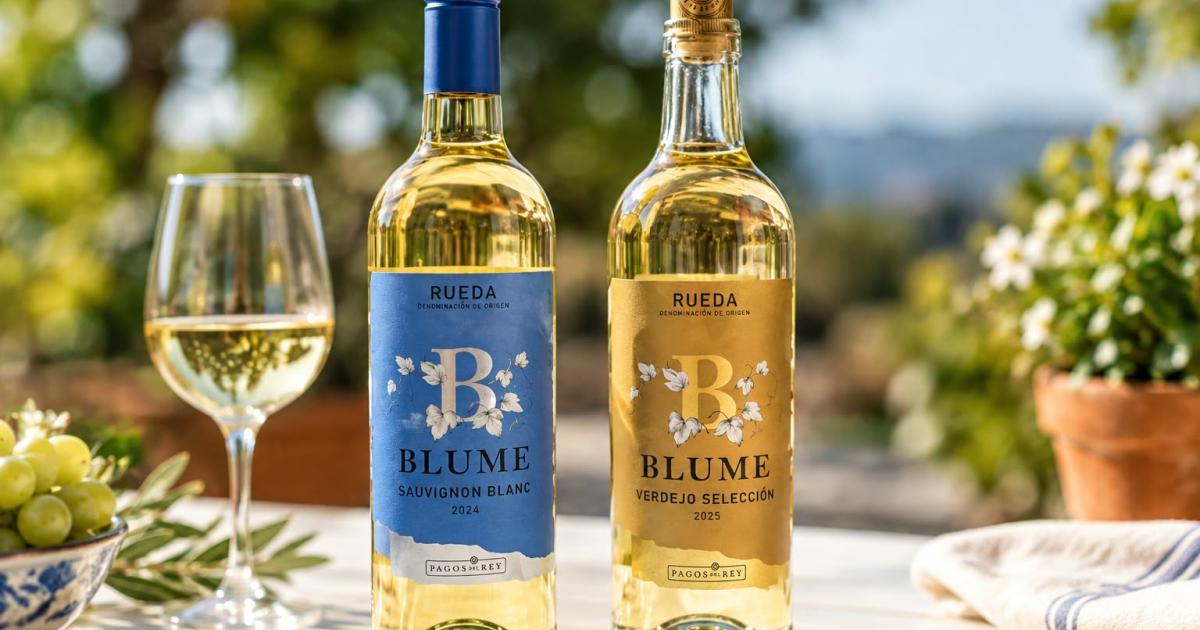
To see how this works in practice, just pick up two bottles from the same producer—for example, the popular Blume wine:
- Gold Label (Verdejo Selección): The true spirit of Rueda, with a traditional cork. The Verdejo grape variety is a local hero—it produces a wine with notes of apples, peaches, and herbs (such as fennel), and a distinctive, slightly bitter finish that brilliantly quenches your thirst.
- Blue Label (Sauvignon Blanc): The same Rueda appellation, but made from an international grape variety and sealed with a modern screw cap. In the glass, you’re transported to a whole different world: crisp acidity, gooseberry, passion fruit, and the freshness of newly mown grass.
Two bottles, the same region, a completely different style—and not a single gram of added sugar in either of them.
Cheat Sheet: How to Order Wine in Spain Like a Local?
If you're going to Spain, forget about using a dictionary to translate your preferences. Instead of looking for "something semi-sweet," say it in Spanish:
- For lunch and tapas: Just ask for un blanco (white) or un tinto (red). If you want a fresh, fruity white, go for a Rueda (Verdejo) or a Galician Rías Baixas (Albariño).
- If you really don't like acidity: Don't look for sweetness—look for wines with lower acidity, from warmer regions, or white wines aged in oak barrels (fermentado en barrica). They’re buttery, velvety, and smooth on the palate, though technically still dry.
- If you absolutely must have bubbles with a hint of sweetness: The only wine where the word “Semiseco” won’t give the waiter a heart attack is Spanish Cava (sparkling wine). There, this classification is fully accepted.
The world of Spanish wine can be intimidating at first, but once you set aside your preconceptions, you’ll discover that “unsweetened water” from a Spanish vineyard simply tastes best in the sunshine.