Elections in Spain: A Complete Guide for the Polish Community. What Do the Notifications on Your Phone Mean, and How Do You Vote Here?
You live in Spain—for example, in sunny Torrevieja—and one morning you receive a notification about the upcoming elections? You see the Spanish terms “Jornada electoral” or “Último día para solicitar el voto por correo” and wonder if, as a Polish citizen, you can vote?
The answer is: yes, but not in every election.
As European Union citizens living in Spain, we have certain voting rights. We can participate in local elections and European Parliament elections, and in certain cases, we can also run for a seat on the municipal council. However, we cannot vote in Spanish parliamentary elections for the Congress of Deputies and the Senate.
It’s worth familiarizing yourself with these rules, as Spanish procedures differ from those we’re used to in Poland. Postal voting, the formalities involved in registering to vote, and voting options for people with disabilities raise a particularly large number of questions.
We've put together a practical guide for Poles living in Spain to help them understand local rules and avoid mistakes.
1. Not every election is for us. Where can Poles vote?
Notifications in city apps, calendars, or local news sites may pertain to elections in which not all residents are eligible to vote. The mere fact of residing in Spain does not automatically grant the right to vote in all elections.
For Polish citizens, there are three main types of elections:
Parliamentary Elections (Elecciones Generales) They include elections to the Spanish Congress of Deputies and the Senate. Spanish citizens who meet the legal requirements are eligible to vote in these elections. A Polish citizen living in Spain cannot, therefore, vote for Spanish lawmakers or directly influence the composition of the national parliament.
Local Elections (Elecciones Municipales) These elections are particularly important for Polish residents. Polish citizens, like other European Union citizens living in Spain, can vote in municipal council elections, or Ayuntamiento. Elected representatives have an impact on many issues related to residents' daily lives: local infrastructure, transportation, public spaces, municipal services, and the functioning of city institutions. Importantly, EU citizens may also run for office in local elections if they meet the requirements set forth in Spanish law.
Elections to the European Parliament (Elecciones al Parlamento Europeo) As Polish citizens, we also have the right to vote in Spain in the European Parliament elections. However, it is important to remember that you are not allowed to vote in the same European elections in two Member States at the same time. If you decide to vote in Spain, you cannot cast a second vote in Poland.
2. Padrón isn't everything. How do you register to vote?
Simply registering with the Spanish municipal registry (Padrón Municipal) is not enough.
In order for a Polish citizen to vote in local or European elections in Spain, they must:
- be at least 18 years old by Election Day;
- be registered on the appropriate voter roll;
- have formally registered your intention to vote in Spain in the appropriate type of election.
The Oficina del Censo Electoral, which operates under the Instituto Nacional de Estadística (INE), is responsible for maintaining the voter registry.
A declaration of intent to vote may be submitted at the municipal office (Ayuntamiento) or electronically via the INE website. For the online procedure, the Cl@ve system is used, and the required residence information must be available in administrative records.
Important information: An EU citizen’s declaration of intent to vote in local elections remains valid as long as that person resides in Spain and does not withdraw the declaration or cease to meet the required conditions.
For the European elections, you must also declare your intention to vote in Spain. It’s a good idea to check whether your prior registration covers both types of elections.
Important for those planning to vote in the upcoming local elections: Voting throughout Spain is scheduled for May 23, 2027. The INE has set December 30, 2026 as the deadline for EU citizens who have not yet completed this formality to register their intention to vote. Those who already have a valid declaration do not need to submit it again.
3. How does voting work in Spain?
The Spanish system primarily provides for two basic methods of voting: in-person voting at a polling place and voting by mail.
In-person voting (Voto presencial)
This is the most traditional and simplest method.
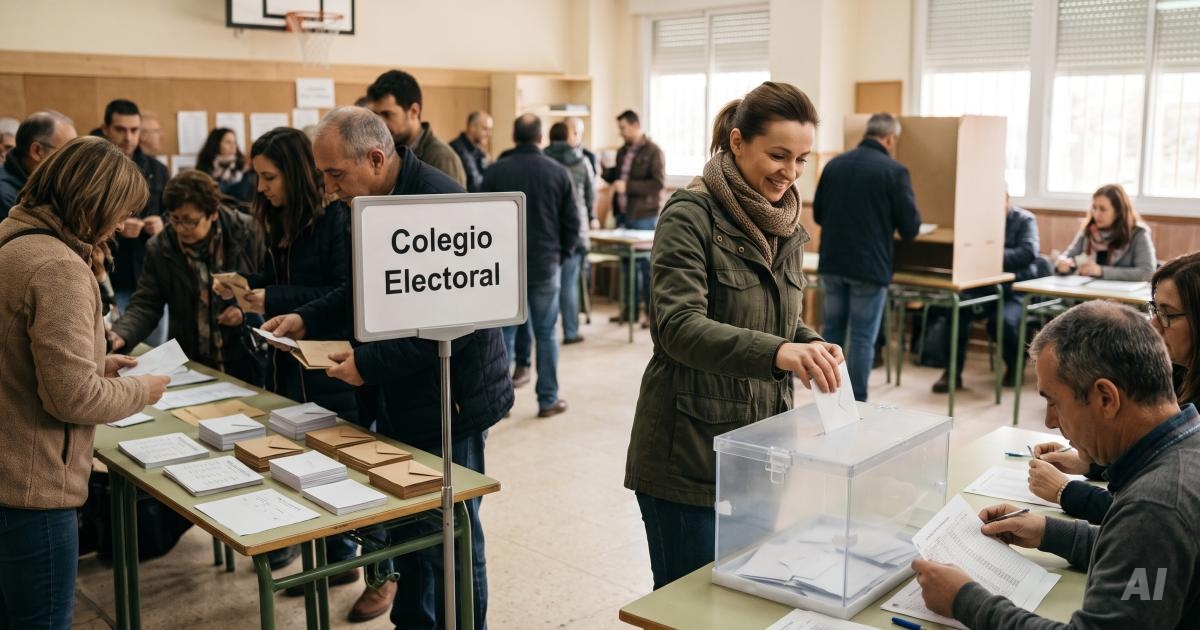
- Polling place: On Election Day, which in Spain is usually a Sunday, voters go to their assigned polling place (Colegio Electoral). Information about the polling place can be found on the voter registration card (Tarjeta Censal), which the government sends to the voter’s home address, or checked on the INE website.
- Identity Verification: Upon entering the premises, you must present a photo ID:
- Polish ID card;
- a Polish passport;
- driver's license;
- an EU citizen's residence registration document (if the person has one).
Official guidelines also permit documents whose validity has expired, provided they allow for unambiguous identification. 3. Voting: After verifying their information, the voter selects the appropriate ballot (Papeleta), places it in the correct envelope, and deposits it in the ballot box. The entire process is free of charge.
Absentee Voting (Voto por correo)
This is an option for people who will be unable or unwilling to go to a polling place on Election Day. In Spain, this is a fully formalized procedure.
Step 1. Submitting an Application
The voter must first submit an application:
- in person at a Correos post office;
- electronically through the official Correos website, using an electronic ID or a digital certificate.
Note: Cl@ve, which is used to register with the INE, is a different system from the authentication methods used in the Correos online application.
Important: If the application is approved by the Oficina del Censo Electoral, the voter may not cast a ballot in person at a polling place.
Step 2. Receiving the election packet
Once the application has been approved, the Oficina del Censo Electoral sends the election documents to the specified address. The package includes, among other things, candidate cards, envelopes, and a document confirming registration on the voter roll (Certificado de inscripción en el censo electoral). Note: The standard procedure for residents of Spain does not allow them to freely provide an address abroad. A separate procedure applies to individuals temporarily residing outside of Spain.
Step 3. Receiving the Package
Election documents are delivered by registered mail with proof of identity. If the recipient is not at home, the package can be picked up at a post office.
Step 4. Preparing Your Voice
The voter selects the appropriate ballot, places it in the ballot envelope, and then inserts it into the return envelope along with the certificate of registration on the voter roll.
The certificate is not a ballot—it confirms your eligibility and is a required component of the return package.
Step 5. Submitting Your Vote
The prepared package must be mailed at a Correos office by the specified deadline. This service is free of charge. Always check the latest announcements from the post office regarding requirements for in-person mailing or any necessary powers of attorney.
4. What if I get sick or become disabled?
Spanish laws provide for measures to make voting easier for people with special needs.
Assistance from a proxy in voting by mail
If a voter’s health prevents them from completing the formalities in person, another person may submit the application on their behalf. However, this does not constitute a power of attorney to vote for a candidate; it is merely formal assistance.
Required documents:
- an official medical certificate confirming that the individual is unable to appear in person;
- an individual power of attorney notarized or certified by a consular officer (the notary’s services for this procedure are free of charge, and the notary can visit your home, hospital, or care facility);
- documents verifying the representative's identity.
Voting for the Blind (Accessible Voting)
The procedure for voters with visual impairments who are familiar with Braille allows them to cast their ballots completely independently and in secret. At the polling place, voters receive a special kit in Braille containing appropriately labeled envelopes.
Important limitation: A special procedure (in accordance with Real Decreto 1612/2007) applies to parliamentary, European, and regional elections—it does not apply to local elections. In local elections, a blind person may receive standard assistance from a trusted companion.
5. Can you vote online in Spain?
No. Spain does not offer online voting for general, local, or European elections.
Only administrative procedures can be handled online:
- register your intention to vote in the INE system;
- submit a request to have a mail package sent at Correos.
Votes are cast exclusively in person: either at the ballot box or by mail. Also, keep in mind that voting in Spain is entirely voluntary.
6. Checklist: What Should You Keep in Mind Before the Next Election?
If you live in Spain and want to exercise your rights, check the following in advance:
- [ ] Are you currently registered with the municipal office (Ayuntamiento)?
- [ ] Have you submitted a declaration of intent to vote in the local elections?
- [ ] Does your declaration also cover the European elections?
- [ ] Are you registered on the Spanish voter registry (Censo Electoral)?
- [ ] Where is your polling place (Colegio Electoral) located?
Summary: Polish citizens also have a say in their Spanish municipality
Life in Spain isn’t just about enjoying the sunny weather and the Mediterranean lifestyle—it’s also about the opportunity to actively participate in the life of the local community. Although we cannot elect the Spanish government, we have every right to decide on matters concerning our neighborhood, our city, and our representation in the European Union.
The upcoming local elections (May 23, 2027) are the perfect time to get your documents in order—keeping in mind that the deadline for submissions is December 30, 2026.
Editor's note: Legal status and dates current as of November 9, 2026.