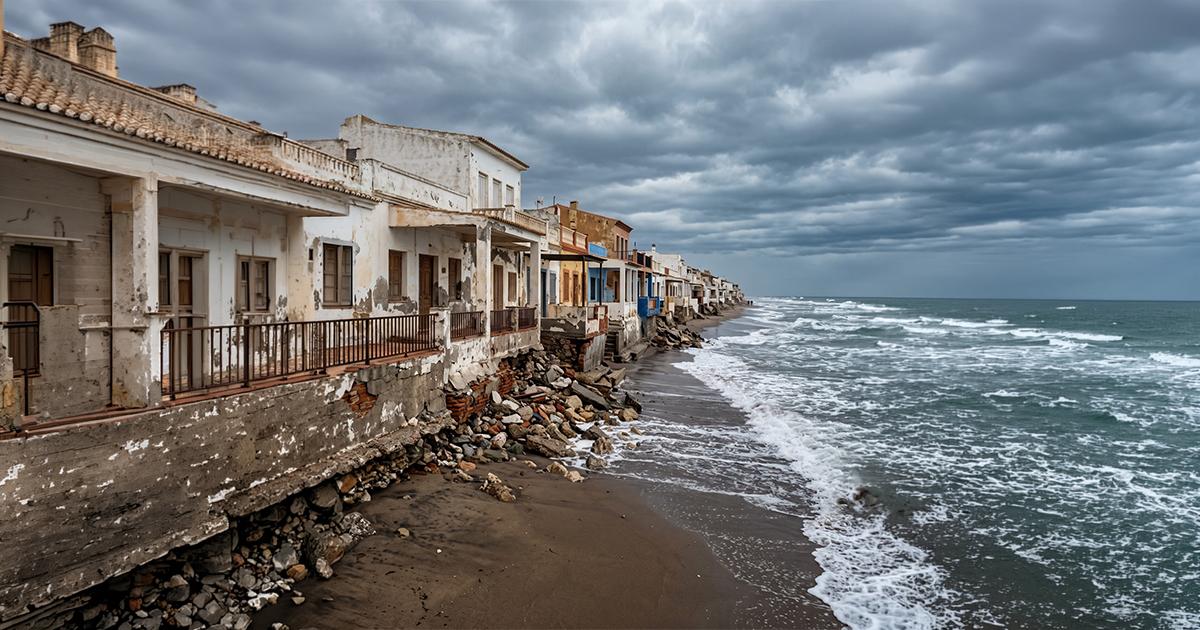
Is this the end of the Babylon homes in Guardamar?
The Constitutional Tribunal Clears the Way for Demolition
The Spanish Constitutional Court has struck down key provisions of Valencia’s coastal protection law, which were intended to prevent the demolition of historic homes on Playa de Babilonia in Guardamar del Segura. The ruling definitively settles the jurisdictional dispute between the regional government and Madrid, giving the national coastal authority free rein to enforce legally binding demolition orders.
For a row of about sixty distinctive, century-old buildings standing directly on the shoreline, this ruling means they will almost certainly be removed from the coastal landscape.
The Clash Between Regional Law and State Jurisdiction
The case was placed on the docket of the Constitutional Court following a constitutional challenge filed by the Prime Minister of the central government against the Law on the Protection and Management of the Valencian Coast (Ley de Protección y Ordenación de la Costa Valenciana).
The main point of contention was Article 17 of this law. This provision allowed regional authorities to initiate a procedure to designate the Babilonia housing complex as an urban area of “special ethnological value.” Such status paved the way for the settlement to be entered into the Valencian cultural heritage registry, which entailed a statutory requirement for its preservation and a de facto ban on demolition.
However, the Constitutional Court ruled that this legal framework was inconsistent with the Constitution as it pertained to maritime zones. In the reasoning, for which Vice President of the Court Inmaculada Montalbán Huertas served as rapporteur, it was emphasized that while the Valencian Community does have the authority to protect cultural and historical values within its territory, such protection may not restrict or prevent the state from exercising its constitutional rights over the so-called maritime-terrestrial public domain (dominio público marítimo-terrestre).
In addition, the Court struck down in its entirety the provision allowing autonomous authorities to create their own registry of “degraded areas,” noting that the central government has the exclusive authority to define the boundaries of the coastal zone.
Expired Licenses and the Power of Nature
The origins of the conflict date back decades, but it reached a climax in 2018, when the long-term concessions for the use of beachfront lots expired. The property owners applied for an extension, but the Spanish Ministry of Ecological Transition denied their request. The case was then referred to the Audiencia Nacional, which ruled in favor of the government.
The Madrid administration's position was based on expert reports from the government institute CEDEX (Centro de Estudios y Experimentación de Obras Públicas). These studies revealed two fundamental problems:
- Coastal erosion: Measurements have shown that for over 80 years, the beach in this area has been receding dramatically due to a lack of sediment carried by the Segura River. This phenomenon has accelerated in recent decades, posing a direct threat of structural collapse to residents and beachgoers.
- Artificial barrier effect: The buildings themselves form a wall that prevents the natural regeneration of the beach and the associated historic belt of dunes and pine forest.
Due to the expiration of the concession, the Costas agency consistently refused to grant residents permits to carry out safety and renovation work. As a result, successive storms—most notably the devastating Hurricane Gloria—reduced some of the buildings to ruins, and the sea began to erode their foundations.
Residents: “The breakwater destroyed the beach, not us”
Homeowners and local associations have for years firmly rejected the claim that the buildings themselves are to blame for the beach’s condition. They point to engineering analyses showing that the main cause of erosion was the construction in the 1990s of a flood-protection breakwater at the mouth of the Segura River.
According to those affected, the artificial pier has permanently altered the dynamics of the ocean currents—instead of carrying the sand deposited by the river southward (to Babilonia Beach), it has begun to direct it northward. Residents feel doubly wronged: first by the government’s misguided hydrotechnical decisions, and then by the ban on protecting their own property from the waves.
Outlook: Bulldozers—Just a Matter of Time
The Constitutional Court’s ruling puts an end to the strategic protective umbrella that the Generalitat Valenciana had extended over the settlement. Final demolition orders, the enforcement of which had been suspended since May 2025 due to a constitutional dispute, no longer face any legal obstacles.
Although the ruling leaves room for the protection of other historic sites along the Valencian coast—provided their permits are still valid (as in the case of the El Pinet enclave in Elche)—the situation in Guardamar del Segura is clear-cut.
This decision sends a clear message to the entire Spanish real estate market: the primacy of state coastal protection over property rights and regional historic preservation policies is absolute, and the status of dominio público is non-negotiable.