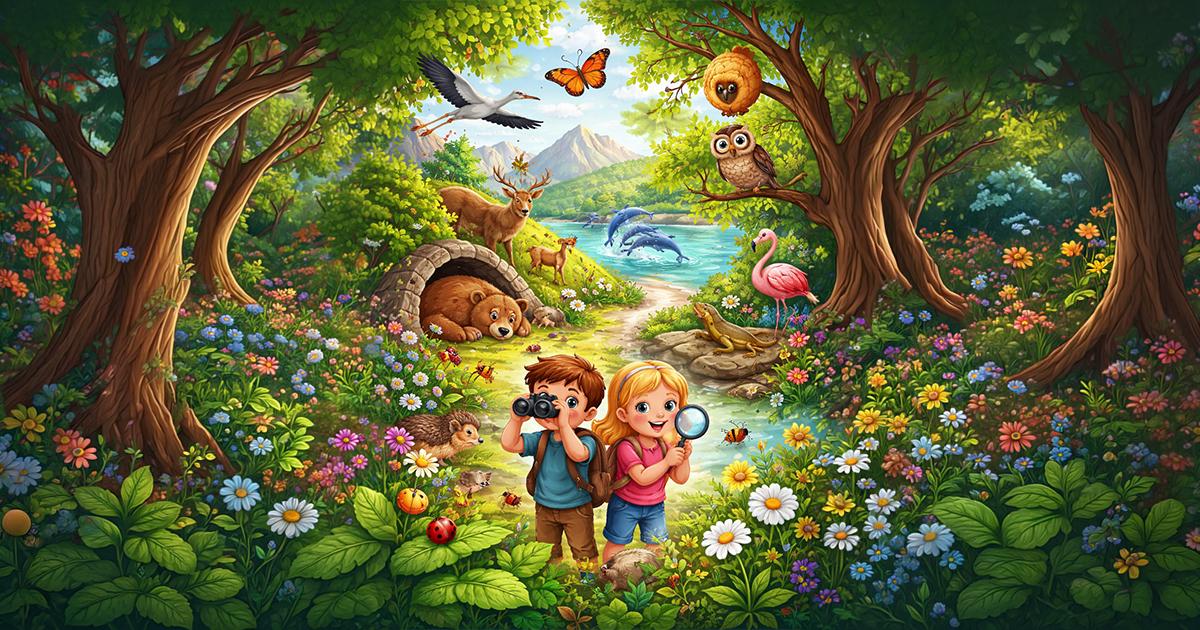
May – The Extraordinary World of Animals and Their Secrets
Welcome, young Explorer!
Are you ready for another adventure? This time, we’re setting off on a fascinating journey into the animal world—a world full of mysteries, clever solutions, and extraordinary abilities. Nature can surprise us at every turn, and animals do things that seem downright magical to humans. All you have to do is look around carefully.
How do animals communicate without words?
Did you know that animals don’t need words to communicate? Their “language” consists of sounds, movements, and smells.
Dogs wag their tails when they are happy or want to say hello. Cats purr when they feel safe and relaxed, but they can also hiss when they are upset. Bees perform their famous “waggle dance,” which they use to tell other bees exactly where to find flowers with nectar—even including the direction and distance!
Dolphins, on the other hand, use whistles and clicks. Scientists have discovered that each dolphin has its own distinctive sound—a sort of name—by which it can be “called” by other dolphins.
This shows that communication is much more than just words—it’s a whole set of signals that you need to be able to interpret.
Masters of Long Journeys
The animal kingdom is full of true travelers.
The storks we know so well from Polish meadows travel as far as 10,000 kilometers each year, flying from Europe to Africa. It is an enormous undertaking that requires strength and excellent navigational skills.
Monarch butterflies undertake one of the longest migrations among insects—their journey can span up to 4,000 kilometers. Interestingly, this route is covered by several generations of butterflies! Whales also travel thousands of kilometers across the oceans. They migrate between cool, food-rich waters and warmer areas where they give birth to their young.
Why do animals migrate? Most often, they are looking for food, better climatic conditions, or a safe place to raise their young. This is one of the most impressive examples of adaptation to life on Earth.
A Dream That Lasts for Months
Imagine falling asleep in the fall and waking up only in the spring. Sound like a fairy tale? For many animals, it’s a reality.
We call this phenomenon hibernation, or winter sleep. Bears, hedgehogs, and certain species of bats significantly slow down their vital functions during this time—their heart rate slows, their body temperature drops, and their bodies consume a minimal amount of energy.
During this time, they neither eat nor drink. They survive on the fat reserves they built up in the fall. This is an extremely effective way to survive the winter, when access to food is limited.
How can we help animals?
The good news is that anyone—even the youngest—can help animals.
In winter, it’s a good idea to feed the birds, making sure to give them the right food, such as sunflower seeds (not bread). In the summer, you can place a shallow dish of water on your balcony or in your garden to help birds and insects survive the heat.
It is also very important not to leave trash in the forest or park. Plastic waste can be deadly to animals.
Another interesting idea is to build an “insect hotel”—a special shelter for solitary bees and other pollinators. Thanks to them, plants can reproduce, and we get fruits and vegetables.
Small actions really do make a big difference.
Animals in Poland and Spain
The animal world varies depending on where we live.
In Poland, you can find roe deer and red deer in the forests, storks in the meadows, and hedgehogs in the gardens. These species are well-adapted to the temperate climate.
In Spain, on the sunny Costa Blanca, you can see lizards basking on warm rocks, flamingos strolling through saltwater lagoons, and dolphins swimming in the waters of the Mediterranean Sea.
Every environment—whether a forest, a meadow, the sea, or a desert—creates different living conditions. That is why the world’s animals are so incredibly diverse.
Fun facts about the animal world – did you know that...?
- Octopuses have as many as three hearts, and their blood is bluish!
- Owls can turn their heads up to 270 degrees, which helps them keep a close watch on their surroundings.
- The cheetah is the fastest land animal—it can reach speeds of over 100 km/h in a short burst.
- Ants can lift a weight up to 20 times their own body weight.
- Dolphins sleep using only one half of their brain, which allows them to control their breathing at all times.
Curiosity is a superpower
Every question you ask brings you closer to discovering something new.
- Why do birds sing at dawn?
- How do fish breathe underwater?
- Why do cats almost always land on their feet?
Never stop observing, asking questions, and searching for answers. That’s how learning begins—with curiosity—because the animal world is one of the greatest adventures right at our fingertips.
In June, we're heading... into space!
We’ll take a look inside a spaceship and see what life is really like for astronauts in zero gravity. You’ll find out why everything floats in space, how you sleep without a bed, and how astronauts eat, work, and stay healthy hundreds of kilometers above Earth.
You’ll learn the story of the first Pole in space — Mirosław Hermaszewski — as well as that of a contemporary astronaut, Sławosz Uznański-Wiśniewski, who flew to the International Space Station in 2025 and conducted scientific experiments there.
You’ll find fascinating facts, true stories, and inspiration for everyone who dreams of traveling beyond our planet.
Because who knows... maybe one day you'll be the one looking down at Earth from space?
The founders of the Polish School on the Costa Blanca INSPIRIA Polish Community Association on the Costa Blanca Katarzyna Hulewicz,
Agnieszka Dziemba