Golden Pens from Spain: Literary Nobel Laureates from the Land of Cervantes
Spanish literature, although it has been one of the pillars of European culture for centuries, has produced only five Nobel Prize laureates in literature. Interestingly, this number is identical to that of Poland, which in itself provides an ideal starting point for reflecting on the similarities and differences between these two literary worlds.
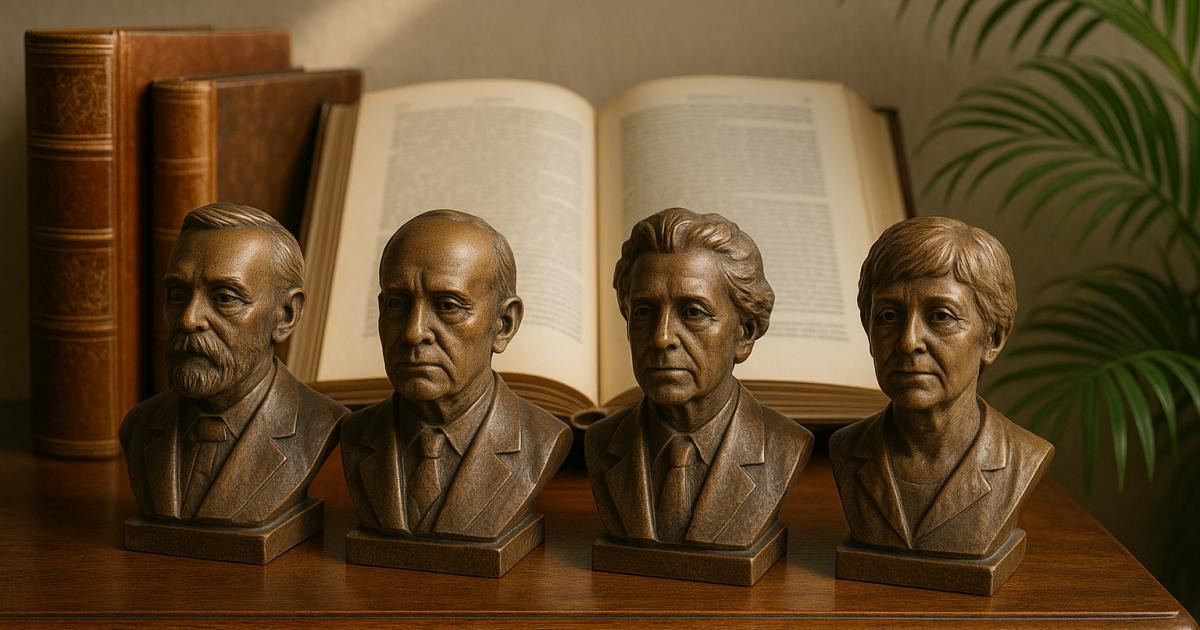
The first Spanish Nobel Prize in Literature was awarded to José Echegaray in 1904. A mathematician, engineer, and playwright, he received the prize for revitalizing Spanish drama and continuing a tradition dating back to the Golden Age of Spanish literature. Less than 20 years later, in 1922, Jacinto Benavente received the prize for his dramatic works, which blended tradition with modernity. His plays were popular not only in Spain but throughout Europe. In the postwar period, in 1956, the Nobel Prize in Literature was awarded to the Spanish poet Juan Ramón Jiménez, a master of lyric poetry and author of the famous “Platero and I” — a poetic tale about a donkey that has become required reading for generations of Spaniards and in In 1977, another poet, Vicente Aleixandre, was honored; his work combined surrealism with reflections on the human condition. The most recent Spanish Nobel Prize in Literature, to date, was awarded to Camilo José Cela in 1989—a novelist who depicted postwar Spain in his novels with brutal honesty and dark humor. Since then, no Spaniard has been honored with this award, although Spanish-language literature—especially Latin American literature—regularly appears among the favorites.
And how does Polish literature measure up against this backdrop? Like Spain, we can boast five Nobel Prize winners in literature: Henryk Sienkiewicz (1905), Władysław Reymont (1924), Czesław Miłosz (1980), Wisława Szymborska (1996), and Olga Tokarczuk (2018, awarded in 2019). Interestingly, both Polish and Spanish laureates often addressed national themes, and their works took on a universal dimension thanks to a profound analysis of human nature. However, there are definitely more similarities.
Sienkiewicz, much like Echegaray, was an artist who built bridges between tradition and modernity. His Quo Vadis brought him international fame, and the author himself emphasized that the award was an honor not only for him but for the entire Polish nation. Benavente and Reymont, in turn, were writers whose works were deeply rooted in the social and cultural realities of their countries— Reymont’s Chłopi and Benavente’s plays are stories about ordinary people, their daily lives, and their dreams.
It is also worth noting that both Miłosz and Aleixandre were poets who, in their works, sought answers to questions about the meaning of existence and humanity’s place in a world full of conflict.
Wisława Szymborska and Camilo José Cela, in turn, are writers who described reality with irony and detachment, unafraid to tackle difficult topics and complex questions. Olga Tokarczuk, the most recent Polish Nobel laureate, like Cela, experiments with form and narrative, creating literature that is open to the world and to dialogue with other cultures.
The Nobel Prize, though awarded to individuals, is always a celebration of an entire nation’s literature. Both Spain and Poland can be proud of their laureates, who prove that the written word has the power to transcend all boundaries—geographical, linguistic, and cultural. The Spanish have been waiting for another prize for 36 years… will this year be a breakthrough for the literature of Cervantes’s country?