Valencia—the city of sunshine, oranges, and futuristic contrasts
On the eastern coast of Spain, overlooking the warm waters of the Mediterranean Sea, lies the country’s third-largest city—Valencia. It’s a place where history intertwines with modernity, and Gothic cathedrals stand side by side with futuristic architecture. It’s the city where paella was born and where one of Europe’s most explosive fiestas—Las Fallas—takes place every year.
From a Roman Camp to a City of the Arts
Valencia was founded by the Romans in 138 B.C. as a settlement called Valentia Edetanorum. In the centuries that followed, it passed through the hands of the Visigoths and then the Moors, who turned it into an important commercial and cultural center. It was the Arabs who created the irrigation system here, which, in a modified form, remains in use today and has made the region famous for its fertile orange and rice crops.
In 1238, King James I the Conqueror conquered Valencia and incorporated it into the Kingdom of Aragon. From that moment on, a period of prosperity began—particularly in the 15th and 16th centuries, when the city was one of the main commercial ports in the Mediterranean.
Modern Valencia
Today, Valencia is a metropolitan area with a population of approximately 800,000 (1.5 million including the suburbs). It is the seat of the Valencian Community government and the third-largest urban center in Spain, after Madrid and Barcelona. It is a modern city, yet one with strong ties to its roots—the Valencian language (a variant of Catalan), local festivals, and a unique culture.
In recent decades, Valencia has undergone a tremendous urban transformation. Futuristic neighborhoods have sprung up on the ruins of old districts, vast green spaces have been created, and one of Spain’s most recognizable landmarks has become a symbol of this transformation...
City of Arts and Sciences
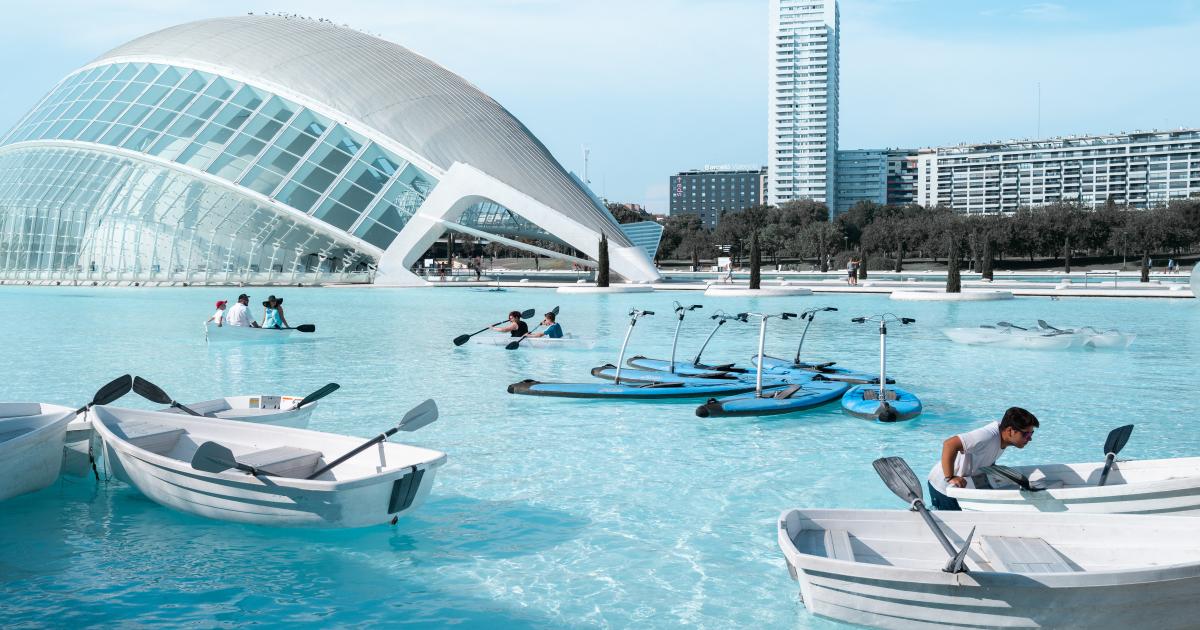
The City of Arts and Sciences is a true showcase of Valencia—a complex designed by the famous architect Santiago Calatrava. Its structures—white, streamlined, and almost otherworldly—resemble buildings from a science fiction movie.
The complex includes, among other things:
- L’Hemisfèric – an IMAX theater and planetarium shaped like a giant eye,
- Prince Philip Science Museum – full of interactive exhibits,
- Oceanogràfic – the largest aquarium in Europe,
- Palau de les Arts Reina Sofia – an ultra-modern opera house and music center.
All of this is surrounded by artificial waterways and parks, creating a unique public space.
Landmarks and the Old Town: A Walk Through History
Although modernity catches the eye, Valencia’s Old Town (Ciutat Vella) captivates with its spirit and atmosphere:
- Valencia Cathedral—built on the ruins of a mosque, in the Gothic-Renaissance style. The Chapel of the Holy Chalice is said to house the Holy Grail!
- La Lonja de la Seda – the former silk exchange, a gem of Gothic architecture, listed as a UNESCO World Heritage Site.
- Torres de Serranos and Torres de Quart—former city gates offering panoramic views of the city.
- Mercado Central – one of the oldest and most beautiful markets in Europe.
The Flavors of Valencia: More Than Just Paella
It was in Valencia that paella originated, and here it is served in its most traditional form: with rabbit, chicken, and beans (known as paella valenciana). In addition to this, you should try:
- Horchata – a refreshing drink made from ground almonds (chufa), particularly popular in the summer,
- Fideuà – a dish similar to paella, but made with noodles instead of rice,
- Turrón – a sweet made from almonds and honey, particularly popular during the holiday season.
Fallas – A Festival of Fire and Noise
Every March, Valencia transforms into a city of fire, fireworks, and colorful figures. Las Fallas is a festival honoring the patron saint of carpenters—St. Joseph. Throughout the year, residents create enormous, often satirical effigies (fallas), which are displayed in the streets and, on the final day, burned during a spectacular night of fire (La Cremà).
Fallas isn't just about fire—it's also about parades, traditional costumes, brass band music, and massive fireworks displays (mascletàs) that literally shake the ground.
Turia – a park on the site of a river
After the great flood of 1957, the Turia River was rerouted through a new channel outside the city. The old riverbed was transformed into the longest urban park in Europe—the Jardín del Turia. It is the green heart of Valencia, perfect for walking, biking, jogging, and relaxing in the shade of palm trees.
Fun Facts About Valencia:
- Valencia was once the capital of Spain—for a short time during the Civil War.
- On many streets, you'll see bilingual signs: in Spanish and Valencian.
- The city has its own version of “bullfighting”—during Fallas, kids throw... water balloons and foam at each other!
Valencia isn’t just a vacation destination—it’s a story about the past and the future, about the taste of paella and the scent of oranges, about art, science, and fire. It’s a city that doesn’t shout—it subtly enchants.